Quick Summary
EPC contractors often reach a point where growth outpaces the systems meant to support it, and the operational strain shows up across engineering, procurement, site execution, and finance all at once. This article breaks down why that happens, what an ERP for EPC contractors should actually include, and how to evaluate whether your firm is ready to invest. If you are weighing spreadsheets against a connected system, this is a practical starting point before you talk to any vendor.
Winning more EPC projects is exciting, but it also introduces a level of operational complexity that spreadsheets and disconnected software simply cannot handle. As project volumes increase, so do procurement requests, subcontractors, engineering revisions, equipment logistics, and financial transactions. And the numbers back this up: McKinsey’s analysis of more than 500 large capital projects worldwide found that cost overruns averaged 79 percent relative to initial budgets, while delays averaged 52 percent against original timelines. Separately, McKinsey research on megaprojects found that 98 percent face cost overruns or schedule delays.
That is not a small-project problem. It is a systemic one, and it shows up first in EPC firms that are scaling faster than their internal systems can support. Deloitte’s 2026 Engineering and Construction Industry Outlook adds another layer to this picture: nearly half of E&C executives now describe their supply chains as fragile, and the industry is projected to need roughly 499,000 new workers in 2026 alone. Growth, rising material costs, and a shrinking labour pool are converging at the same time, which means the margin for operational inefficiency is shrinking too.
This is where ERP for EPC contractors becomes a strategic advantage, not a nice-to-have. If you are evaluating whether your firm has reached that tipping point, here is what you need to know before you invest.
Why EPC Contractors Reach a Breaking Point
Growth is the goal. But growth is also what exposes every crack in a disconnected system. Here is what that shift typically looks like:
| Then | Now |
|---|---|
| 3 active projects | 10+ active projects |
| 50 vendors | 300+ vendors |
| One procurement request at a time | Dozens of concurrent purchase requests |
| A small, co-located site team | Multiple site teams across locations |
| Manually tracked equipment | Fleets of shared, moving equipment |
| One spreadsheet per project | Dozens of disconnected spreadsheets, each with its own version of the truth |
None of these changes happen overnight, which is exactly why they are so easy to miss. A firm does not wake up one day and decide its systems are broken. It slowly loses visibility, project by project, until leadership is making decisions on data that is already weeks old.
what does that loss of visibility actually cost a firm, department by department?
The Biggest Operational Challenges Facing EPC Contractors
Every department feels this strain differently. Here is where it shows up most, and why each one is harder to fix in isolation than it looks.
Engineering Challenges
The most common breakdown here is revision confusion. When BOQ changes and document approvals live in email threads instead of a single system, site teams end up executing against outdated drawings. This is rarely a one-time mistake. It compounds:
- A revised drawing gets approved by the client but is not pushed to the site team the same day.
- Procurement, still working from the old BOQ, orders materials that no longer match the revised scope.
- Site crews discover the mismatch mid-installation, triggering rework, wasted labour hours, and a change order dispute with the client over who is responsible for the extra cost.
None of this happens because engineering teams are careless. It happens because the revision lives in one inbox, the BOQ lives in another system, and nothing forces the two to stay in sync automatically.
Procurement Challenges
Delayed purchases, endless vendor follow-up, and material shortages on site are rarely caused by a lack of effort. Deloitte’s 2026 outlook notes that tariff-driven material cost increases and fragile supply chains are already straining thin margins across the industry, which makes procurement timing more critical than ever. In a disconnected system, procurement teams are usually working from information that engineering or site teams have not yet shared, which means:
- Purchase requests get raised only after a shortage is already visible on site, not before.
- Vendor negotiations happen under time pressure, which weakens pricing leverage.
- Emergency purchases at premium prices become routine rather than exceptional, quietly eroding margin on every project.
Construction Site Challenges
Poor site visibility, unplanned equipment downtime, and inefficient labour allocation compound quickly on multi-site operations. When a project manager cannot see real-time site status, three things typically happen: labour gets allocated based on yesterday’s plan rather than today’s actual progress, equipment sits idle on one site while another site is waiting for the same machine, and small delays go unnoticed until they have already pushed the schedule back by days. With Deloitte projecting a labour gap of nearly 500,000 workers in 2026, every hour of inefficient labour allocation carries a higher cost than it did even two years ago.
Finance Challenges
Cost overruns, delayed billing, and cash-flow uncertainty are often the last symptoms to appear, but they are the most expensive. By the time finance sees a variance in a monthly report, the decision window to correct it has usually already closed. This creates a specific and costly pattern in EPC firms: work gets completed on site weeks before it gets billed, because billing depends on manually reconciling site progress reports, procurement records, and subcontractor invoices that live in three different systems. The result is a cash-flow gap that grows in direct proportion to how many active projects a firm is running.
Management and Reporting Challenges
No real-time dashboards. Excel-based reporting stitched together at month-end. Decisions made on data that is already stale. This is the challenge that sits above all the others, because it means leadership is always reacting, never anticipating. A management team compiling a portfolio-wide status report by manually pulling numbers from ten different project spreadsheets is not just working inefficiently, it is making strategic decisions, like which projects to bid on next, based on information that may already be a month out of date.
“By the time cost overruns show up in a report, the window to correct them has already closed.” This is the core argument for real-time visibility, and it is the thread that connects every department above.
Naturally, this raises the question: why do the tools most EPC firms already use fail to prevent this?
Why These Problems Persist With Traditional Tools
It is not that Excel, WhatsApp, or email approvals are bad tools. It is that none of them were built to connect to each other.
- Excel handles planning well in isolation, but every version saved outside a shared system becomes its own island of truth.
- Accounting software (like Tally) tracks finance accurately, but it has no visibility into what is happening on site or in procurement.
- WhatsApp moves fast for day-to-day coordination, but nothing said in a chat thread is searchable, auditable, or tied to a project record.
- Email approvals create a paper trail, but not a structured one, so tracing an approval back to a BOQ change means digging through inboxes.
- Separate inventory systems track stock, but not against real-time project demand.
Individually, fragmented tool does its job. Collectively, they trap information in silos, and information trapped in a silo is information leadership cannot act on. This is precisely the gap that a purpose-built ERP for EPC contractors is designed to close.
Check our Success Story
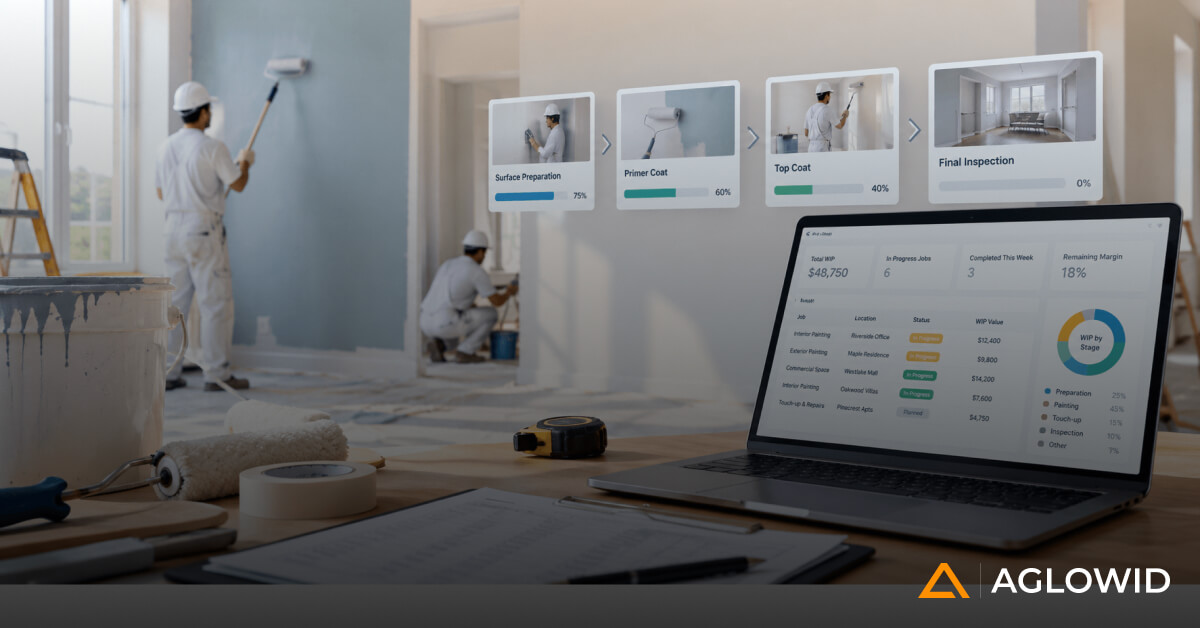
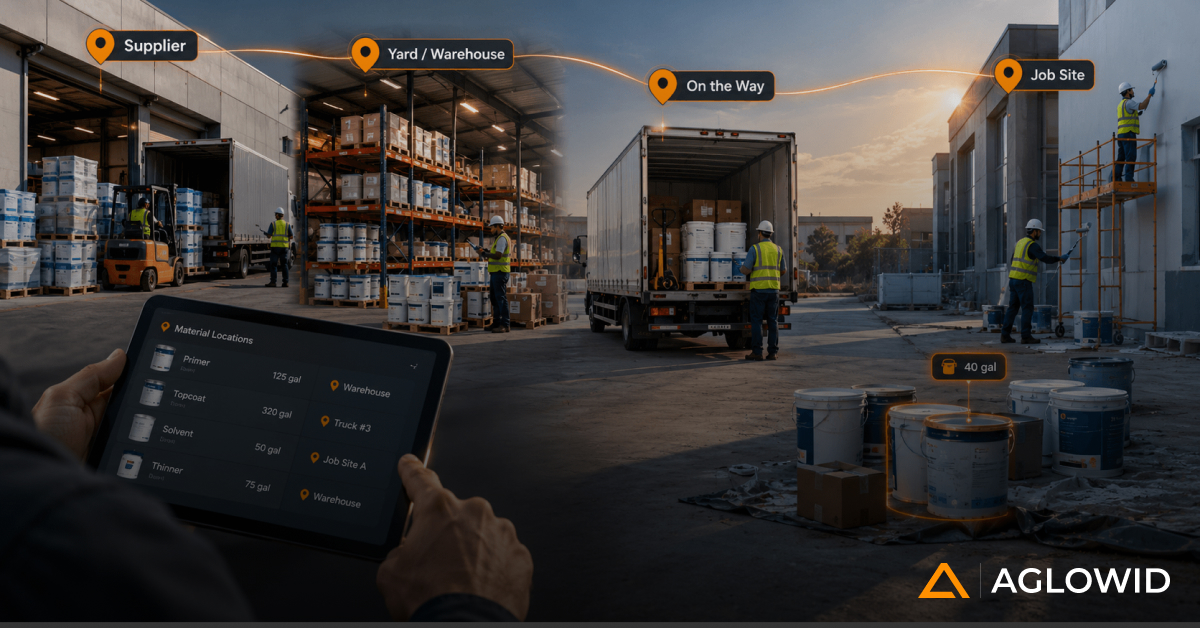
ERP Software for Painting & Coating Contractors
Centralizing Field, Finance, and Compliance with Odoo
Industry: Painting & Coating/Construction
Location: Canada
What an ERP for EPC Contractors Should Include
Rather than a list of modules, think of this as a list of what stops breaking once each piece is in place, and why that specifically matters for EPC work rather than construction in general.
Project Planning and Scheduling
Keeps every team, engineering, procurement, site, and finance, working against the same timeline instead of their own version of it. When a schedule slips on one workstream, every dependent workstream should see that change immediately, not discover it a week later during a status call.
BOQ and Estimation
Removes the disconnect between what was estimated and what gets executed. Because BOQ revisions in EPC work happen constantly during the engineering phase, this module needs to update procurement and costing automatically, not require someone to manually re-key the changes into three other systems.
Procurement
Surfaces material needs before they become site emergencies, by tying purchase triggers directly to the project schedule and current BOQ rather than to a manually raised request. This is also where vendor performance history should live, so recurring delays from a specific vendor become visible before they cause a shortage again.
Inventory and Warehouse
Prevents both material shortages and costly overstocking by tracking stock against real, current project demand rather than static reorder points. For construction companies running multiple sites, this also means visibility into whether material sitting idle at one site could be transferred to another instead of ordering new stock.
Equipment Management
Reduces idle time by showing where every asset actually is, which project it is allocated to, and when it becomes available next. This directly targets one of the most overlooked cost leaks in EPC operations: equipment sitting unused on one site while another site pays for a rental.
Labour and Subcontractor Management
Ties workforce allocation directly to project schedules and tracks subcontractor performance, compliance documentation, and payment milestones in one place. As subcontractor counts grow into the hundreds, the administrative burden of manually tracking this becomes a full-time job in itself, one this module is built to absorb.
Project Costing
Flags budget variance while there is still time to act on it, by comparing actual costs against the BOQ in real time rather than at month-end. This is the single biggest lever for addressing the cost overrun statistics cited earlier in this guide.
Billing
Connects completed work to invoices without manual reconciliation, using site progress data and procurement records that already live in the same system. This is what closes the cash-flow gap described in the finance challenges above.
Finance and Accounting
Gives finance real project-level cost data, not estimates pulled together after the fact. This also means finance can see project profitability in real time, not just at project close.
Document Management
Ensures every team is working from the current revision, not an outdated one, with a clear audit trail of who approved what and when. This directly addresses the engineering revision problem described earlier.
Mobile Site Reporting
Brings site data into the system the same day it happens, not weeks later, by letting site supervisors log progress, material usage, and labour hours directly from a phone or tablet.
Dashboards and Analytics
Turns scattered data into a single, real-time view for leadership, replacing the month-end spreadsheet compilation described in the management challenges section above.
Individually, each of these solves one problem. Together, they solve the bigger one: a lack of a single source of truth across the entire project lifecycle.
How ERP Connects Every Department in EPC
The real value of ERP for EPC contractors is not any single module. It is the workflow that connects all of them into one continuous
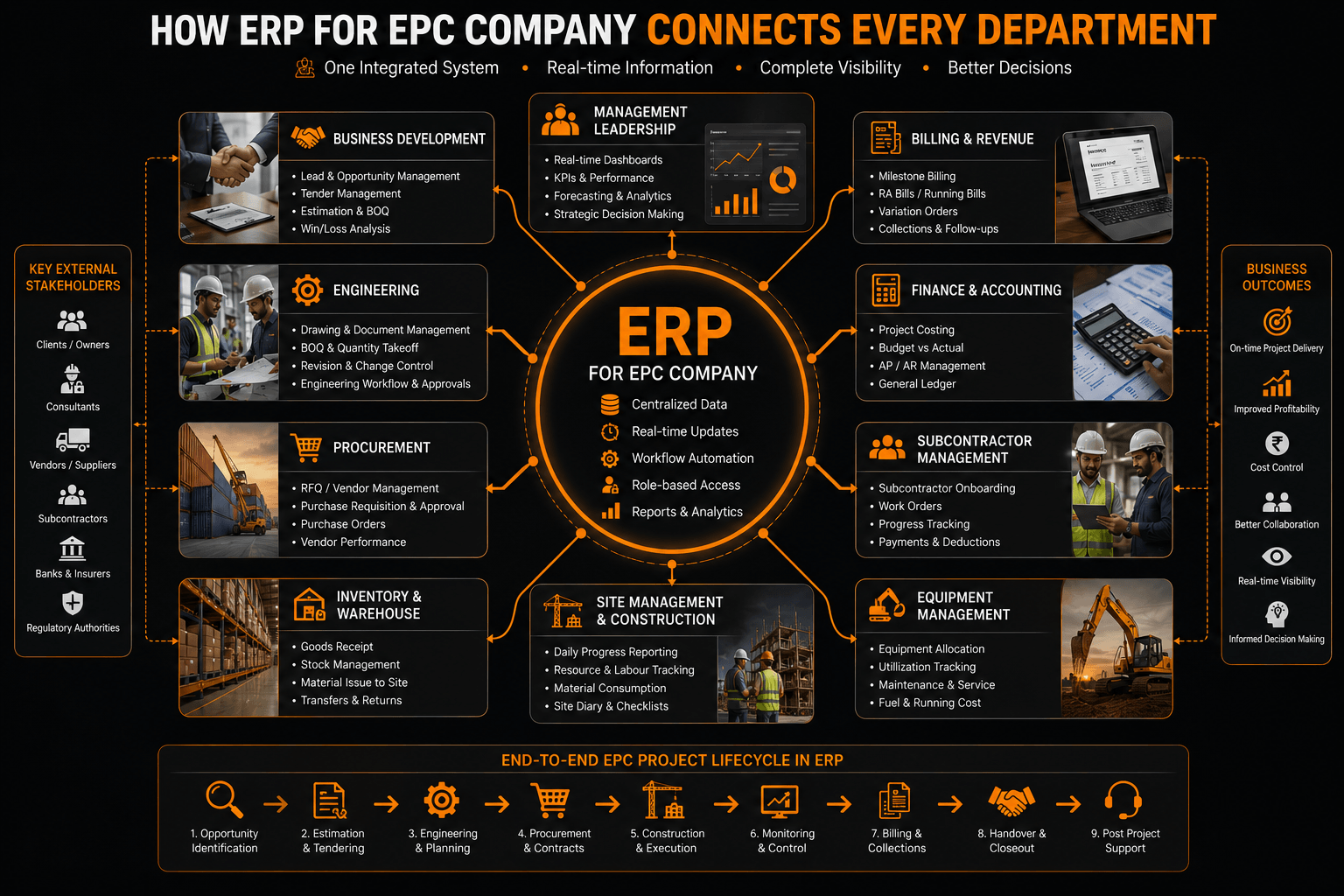
Every arrow in that chain represents a handoff that, in a disconnected system, usually happens through email, a phone call, or a spreadsheet update that someone forgets to share. Walk through what changes at each handoff once ERP is in place:
- When engineering finalizes the BOQ, procurement sees it the same moment, not after someone forwards a file.
- When a purchase order is issued, inventory already knows what is arriving and when, so site teams are not caught off guard by a delivery, or by its absence.
- When site execution begins, daily progress updates feed directly into finance, so cost tracking reflects what is actually happening on site rather than what was originally planned.
- When client billing is generated, it is built from verified progress data already in the system, not reconstructed after the fact from separate records.
- When the management dashboard updates, it reflects all of the above in real time, not a snapshot from three weeks ago.
That is the difference between managing a project and reacting to one. So what does that difference actually translate to for the business? That is where the numbers matter most to decision-makers.
Benefits That Matter to Decision-Makers of EPC Company
| Business Challenge | ERP Outcome | Why It Matters |
|---|---|---|
| Cost overruns | Real-time cost control and early variance alerts | Catches budget drift while there is still time to correct it, directly addressing the 79 percent average overrun McKinsey found in large capital projects |
| Delayed procurement | Faster, connected purchasing cycles | Materials arrive when site actually needs them, reducing emergency purchases at premium prices |
| Poor cash flow | Faster, more accurate billing and collections | Shrinks the gap between work completed on site and cash received from the client |
| Material wastage | Inventory visibility tied to real project demand | Less overstock sitting idle, fewer last-minute emergency purchases |
| Idle equipment | Centralized equipment tracking and scheduling | Higher utilization across active sites, less unnecessary rental spend |
| Manual reporting | Real-time dashboards instead of month-end spreadsheets | Decisions made on current data, not data that is already weeks old |
| Slow approvals | Structured, automated approval workflows | Fewer bottlenecks between engineering, procurement, and site teams |
| Limited project visibility | Centralized, cross-department project tracking | One source of truth across the entire project lifecycle, not five disconnected ones |
| Subcontractor and labour strain | Centralized subcontractor and workforce management | Reduces administrative overhead as subcontractor counts grow, which matters given the labour shortages Deloitte projects for 2026 |
None of these outcomes require a firm to be enterprise-scale to benefit from them. In fact, firms often feel the impact faster, because they are still small enough to change how work gets done without a multi-year rollout.
Signs It’s Time to Invest in EPC company ERP
If several of these sound familiar, that is usually a strong signal, not a coincidence:
- You are managing multiple active projects at once, and no single view shows all of them accurately.
- Your team is heavily dependent on spreadsheets that get emailed back and forth.
- Procurement delays keep recurring, even after you have addressed the “obvious” causes.
- You have limited visibility into which projects are actually profitable until they close.
- Coordinating teams across multiple sites takes constant manual follow-up.
- Your subcontractor count keeps growing, and so does the admin work to manage them.
- Getting a management report together takes days, not minutes.
If three or more of these apply to your firm right now, the cost of waiting is likely already higher than the cost of acting.
Choosing the Right ERP for EPC Contractors
Not all ERP systems are built for construction, and that distinction matters more than most vendors will tell you upfront. Here is what to actually evaluate, and why each one matters specifically for EPC work rather than construction broadly.
Construction-specific functionality Generic ERP handles inventory and finance well, but it rarely handles BOQ-driven costing or site-level workflows the way EPC work demands. A system built for retail or manufacturing inventory will not understand why a BOQ revision needs to cascade into procurement automatically.
EPC workflow support The system should mirror the tender-to-billing flow described earlier in this guide, not force your team to adapt its process to fit the software’s structure. If implementation requires your engineering team to change how they issue revisions just to fit the system, that is a sign of a poor fit.
Scalability What works cleanly for 10 projects should still work cleanly at 50, without a system migration in between. Ask any vendor directly how their platform performs as project and vendor counts grow, not just how it performs in a demo with sample data.
Mobile accessibility Site data is only useful if it can be captured on site, not re-entered later from a paper form. Given the labour and connectivity realities of most job sites, this needs to work reliably on a phone, including with limited connectivity.
Customization options Every EPC firm’s approval chain and costing structure is slightly different. Rigid systems create workarounds, and workarounds recreate the exact silos you were trying to eliminate in the first place.
Integration capabilities Your ERP does not need to replace every tool you use, but it does need to talk to the ones you keep, particularly existing accounting software and any specialized design or estimation tools your engineering team already relies on.
Reporting and dashboards If leadership cannot see project status in real time, the ERP has not actually solved the original problem, it has just moved the same delay into a different piece of software.
Vendor experience in construction A vendor who understands EPC workflows will ask better implementation questions than one adapting a generic template built for a different industry. Ask for references from other EPC firms specifically, not just construction firms broadly.
Frequently Asked Questions
What does ERP cost for an EPC contractor? Costs vary widely based on user count, modules needed, and deployment type (cloud versus on-premise). Most firms should budget for both a licensing or subscription cost and an implementation cost, since configuration to your specific workflows is where most of the value gets built.
How long does ERP implementation take for a construction company? For a EPC firm, a phased rollout typically takes a few months rather than weeks, especially if data migration from multiple legacy systems is involved. Firms that phase implementation by department, starting with procurement and finance, tend to see value faster than those attempting a single company-wide launch.
Is ERP worth it for a company managing fewer than 10 active projects? Often yes, particularly if vendor count, subcontractor volume, or reporting delays are already causing friction. The signs listed earlier in this guide are a more reliable indicator than project count alone.
What is the difference between generic ERP and EPC-specific ERP? Generic ERP handles finance and inventory well but usually lacks BOQ-driven costing, construction-specific procurement workflows, and site-level mobile reporting built around how EPC projects actually run.
Can ERP integrate with existing accounting software? Most modern ERP platforms are built to integrate with, or fully replace, existing accounting tools. Which approach makes sense depends on how deeply your finance team wants project-level data connected to company-level books.
The Future of ERP in EPC
A few capabilities are already reshaping what ERP for EPC contractors looks like over the next few years. Deloitte’s research on digital adoption in construction found that data analytics tools are now used by 56 percent of construction businesses, cloud-based construction management software by 50 percent, and AI or machine learning tools by 46 percent, up from roughly a quarter of businesses just a few years earlier. That trajectory points toward a few specific capabilities worth watching:
- AI-assisted forecasting, using historical project data to flag likely cost overruns before they happen, not after.
- Predictive procurement, which anticipates material needs based on schedule changes rather than waiting for a manual request, an increasingly important capability given how fragile supply chains have become.
- Automated project reporting, reducing the manual effort currently spent assembling month-end dashboards.
- Mobile-first site operations, where field data updates the system the moment it is captured.
- IoT-enabled equipment monitoring, connecting machine-level data directly to project costing and utilization reports.
These are worth watching, but the fundamentals matter more than the future features. A firm that cannot see its current project data in real time will not benefit from predictive tools layered on top of it.
Conclusion
For EPC contractors, ERP is not just about replacing spreadsheets. It is about gaining the visibility, coordination, and control needed to deliver projects on time, protect margins, and scale with confidence. The right ERP creates a single source of truth across engineering, procurement, construction, and finance, helping leaders make faster, more informed decisions instead of reacting to reports that are already out of date.
If your firm is showing even a few of the signs covered in this guide, the conversation worth having is not whether ERP is necessary, but which system actually fits how your projects run.
Ready to see what this looks like for your projects?
Talk to our team for a walkthrough of how ERP for EPC contractors can connect your engineering, procurement, site, and finance teams into one system, built around how EPC work actually happens.