Quick Summary
Growing painting contractors often run twenty or more active jobs at once, and each department, field, project management, finance, sees a different piece of the same project. That gap is exactly why WIP reporting for painting contractors tends to break down into a slow, manual reconciliation exercise instead of something leadership can act on in real time. This blog walks through why that happens, what it actually costs when margin erosion goes unnoticed until closeout, and how connecting project and financial data through an ERP turns WIP from a monthly autopsy into an early warning system.
Most contractors don’t lose margin on one bad day. They lose it quietly few percentage points at a time, across labor overruns, material waste, scope changes, and projects that start drifting before the financials catch up. A 2024 review of more than 300 construction studies found that cost and time deviations most often emerge during project execution exactly when early visibility matters most.
So the question is, What if your field team already knows a project is drifting, but your financial reporting won’t show it for another few weeks? That gap between what is happening on the job and what the numbers eventually reveal is where margin starts disappearing. WIP reporting for Painting Contractors is ultimately about closing that gap and giving management enough visibility to act before a small variance becomes a finished-project loss.
Your Projects Are Moving. Is Your Financial Reporting Keeping Up?
A growing painting contractor rarely gets the luxury of running one job at a time. Twenty active projects across commercial, residential, and industrial work is a normal Tuesday. And on that Tuesday, three different parts of the business are each working off a different version of the truth.
The field team knows which jobs are moving on schedule, where crews are fighting access or surface issues, which projects need rework, and which change orders are still sitting in someone’s inbox waiting on a signature.
Finance knows what’s been billed, what costs have posted to the ledger, and what revenue has technically been recognized.
Project managers know estimated hours, remaining scope, and roughly when they expect to close out.
None of these views is wrong, exactly. They just don’t answer the one question the CEO actually needs answered: which of your twenty jobs is about to surprise you, and which one is next quarter’s write-off?
That’s the entire reason WIP, or Work in Progress, reporting exists. In theory, it’s the one place where operational reality and financial reality are supposed to meet on a single page. In practice, for most growing contractors, it’s closer to a monthly act of translation, done under deadline, by whoever on the finance team has the patience to turn five spreadsheets into one number leadership can actually use.
This article gets into why that translation keeps breaking down, what it costs when it does, and how connecting project and financial data through an ERP for painting contractors turns WIP from a rearview-mirror report into something you can actually steer with.
Why Traditional WIP Reporting Breaks Down for Painting Contractors
The breakdown usually isn’t a software failure. It’s a data ownership failure.
A growing contractor’s project information tends to live scattered across a chain of tools that were never built to talk to each other: Estimating, Project Management, Time Tracking, Purchasing, Accounting, and, almost always, a stray Excel file somewhere. None of these systems is bad at its job, individually. The estimating tool estimates fine. Payroll tracks hours accurately. Accounting posts costs correctly. The problem is structural: no single system has the full picture, and nobody’s job is to stitch them together in real time.
Here’s what that looks like on one project, on any given week:
- The project manager says the job is 70 percent complete, based on what the field is seeing.
- Accounting shows only 55 percent of expected revenue has actually been billed.
- Payroll has recorded meaningfully more labor hours than the original estimate allowed for.
- Purchasing has additional material commitments that haven’t hit the cost report yet.
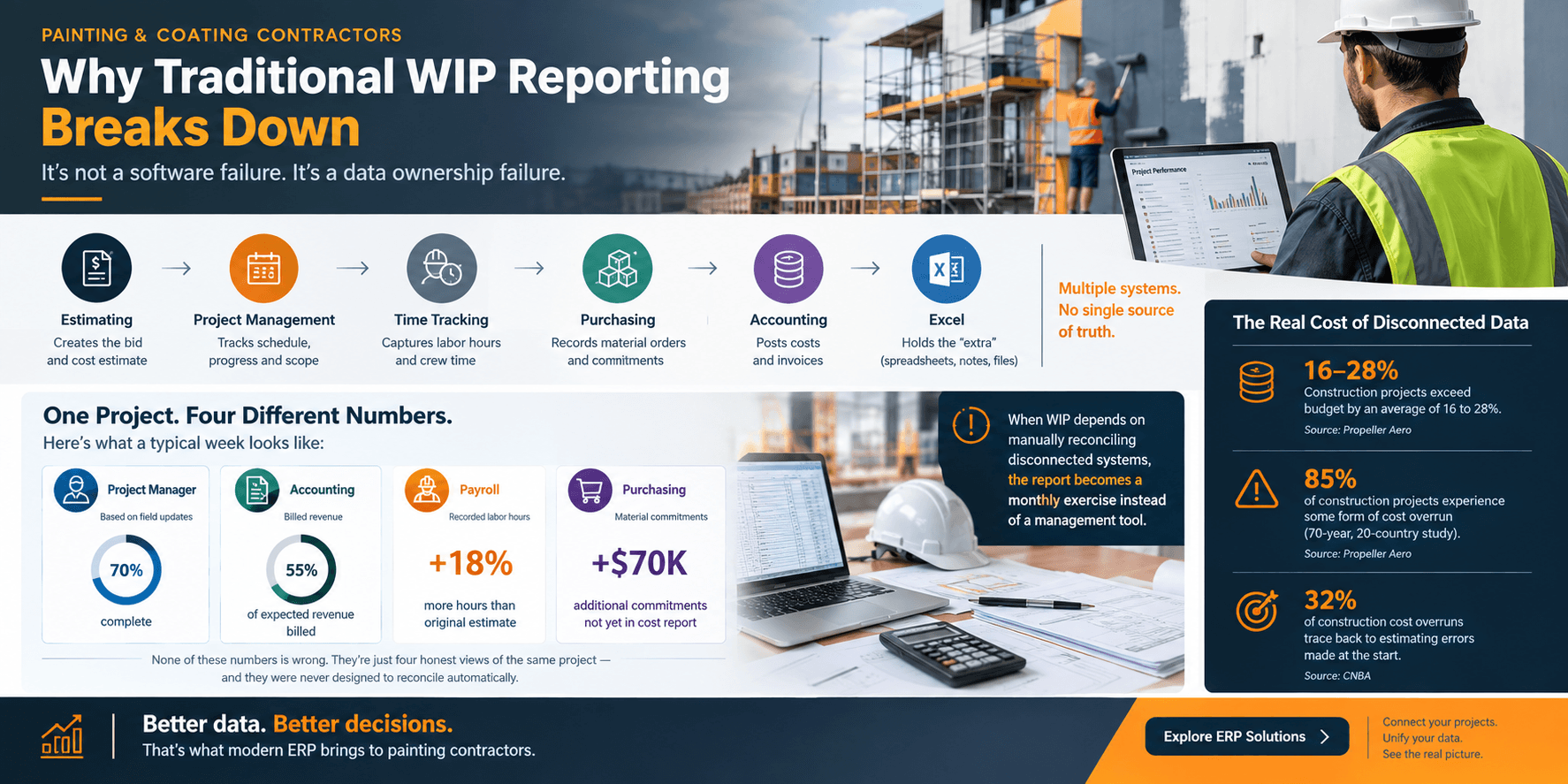
None of these four numbers is technically wrong. They’re just four honest views of the same project that were never designed to reconcile with each other automatically. So the controller does what controllers have always done: pulls every report, opens a spreadsheet, and manually rebuilds one version of the truth by hand.
When WIP depends on manually reconciling disconnected systems, the report becomes a monthly exercise instead of a management tool.
And the timing cost is real, not theoretical. By the time that reconciliation is done, the number driving the conversation is already a few weeks stale, and the window it was supposed to inform has usually already closed.
This isn’t a niche problem, either. Construction cost overruns are stubbornly common industry-wide. Nationwide, construction projects exceed budget by an average of 16 to 28 percent, and one study covering seventy years of projects across twenty countries found that roughly 85 percent experienced some form of cost overrun. Separately, about 32 percent of construction cost overruns trace back to estimating errors made at the very start of the process. When the front end of a project is already shaky and the reporting in the middle is slow, those two problems don’t just add up, they compound. This is the place you need to go with WIP reporting Automation.
What Management Actually Needs to See on Every Painting Job
Once you see the disconnect, the answer isn’t giving leadership another fifteen KPIs to look at. They don’t need more numbers. They need a few answers they can get quickly and trust.
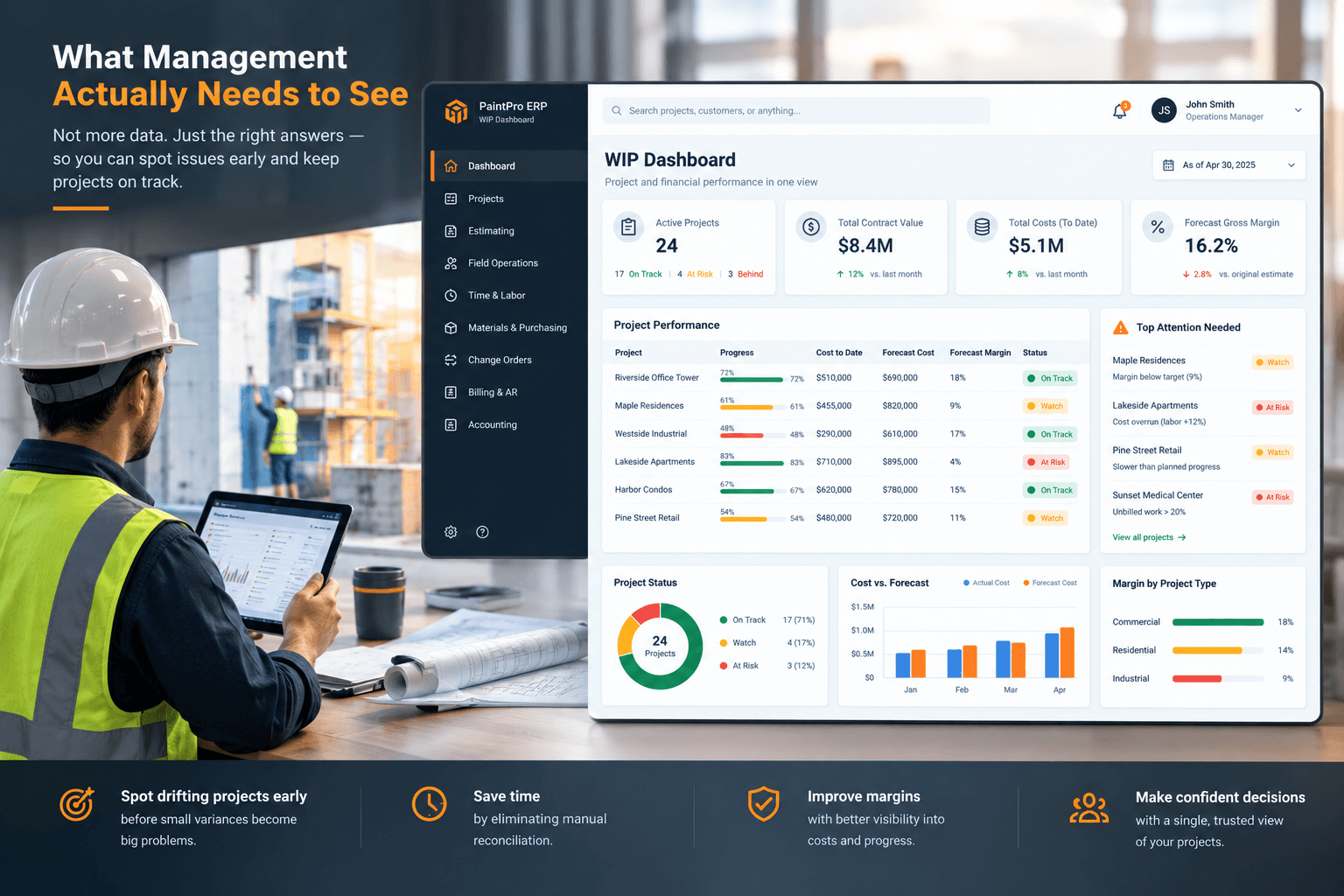
- Where is the project today? Is progress actually where it should be?
- What has it cost so far? Including labor, materials, subcontractors, and other direct costs.
- Where is it likely to finish? Based on what is happening now, not just what was estimated at the start.
- What needs attention? Which projects are starting to move in the wrong direction?
A simple WIP dashboard built on connected project and financial data can bring those answers together:
| Project | Progress | Cost to Date | Forecast Cost | Forecast Margin | Status |
|---|---|---|---|---|---|
| Project A | 72% | $510K | $690K | 18% | On Track |
| Project B | 61% | $455K | $820K | 9% | Watch |
| Project C | 48% | $290K | $610K | 17% | On Track |
The numbers above are illustrative, but the point is easy to see. Project B deserves attention. At 61% progress, its forecast margin has already fallen to 9%. That doesn’t necessarily mean the project is in trouble. It means there is still time to understand what’s driving the variance and decide whether something needs to change.
And that’s where a connected WIP reporting for Painting Contractors view becomes useful. Management shouldn’t have to rebuild a project from five different systems just to find out which jobs need attention. The goal is to make that signal visible early enough for someone to actually do something about it.
The Data Behind a Reliable WIP Report
To go from what leadership sees on that dashboard to how it actually gets built, it helps to understand where the underlying numbers come from. This is the one section that gets a little technical, so we’ll keep it short.
A WIP report is only as good as the weakest link feeding it, and that data moves through roughly four stages of a project’s life:
- At the beginning: the estimate. Labor, materials, subcontractor costs, and the margin the bid was built around.
- During execution: actuals. Employee hours, material cost tracking, purchase costs, subcontractor invoices, job-related expenses as they happen.
- As scope changes: change orders. Approved additions, revised contract value, and whatever extra cost those changes bring with them.
- As the project moves forward: updated progress and forecast. Work done, work left, and a revised cost to complete.
All four of those streams eventually feed billing and accounting, and all four eventually feed the WIP view leadership is looking at.
Put simply, a WIP report for painting contractors is only as reliable as the project data behind it. That’s worth remembering even when the mechanics feel like something better left to a project accountant than to a CEO’s morning briefing.
How ERP Changes the WIP Reporting Process for Painting Contractors
This is where the shift from problem to solution actually happens, and it’s worth being precise about what changes.
The difference isn’t cosmetic. The ERP doesn’t just create the report. It makes the information required to produce the report part of the operational workflow itself.
That’s the strongest argument for connected systems in this whole article, honestly, and it’s worth sitting with for a second. When a foreman logs hours against a project code, that data doesn’t sit around waiting for payroll to run before anyone can see it. When a change order gets approved, the revised contract value and expected cost update inside the same system the WIP report pulls from, not in a separate email thread someone has to remember to go reconcile later.
This is roughly the direction the broader construction industry is already heading. Nearly 70 percent of construction professionals now rate real-time data as a very or extremely important requirement for their systems, and the construction ERP market itself is projected to grow at close to a 7.7 percent compound annual rate through 2034 as more firms move past basic accounting software. But adoption alone isn’t the finish line. The same survey found that among firms already using cloud ERP, only about 11 percent reported a significant improvement in visibility, forecasting, or decision-making, while most saw little to no change at all, something the report chalks up to shallow implementation rather than the technology itself. The takeaway for a growing contractor: the value isn’t in owning an ERP. It’s in how deeply project and financial data are actually connected inside it.

See what a connected WIP process looks like on your own projects
Stop reconciling five spreadsheets to answer one question. Book a short call and we’ll walk through what real-time WIP reporting would look like on your current job list, using your own project data.
The Real Value: Catching Problems Before They Become Final Losses
This is where the conversation stops being about software and starts being about the business itself.
Take a project estimated at 1 million dollars in contract value, with an expected total cost of 800,000 dollars and a planned margin of 20 percent. Halfway through, a connected system shows labor consumption running above estimate, material costs climbing, progress slower than planned, and the estimated cost to complete creeping up along with it.
On the surface, the project can still look profitable. But the forecast has quietly shifted underneath it. Expected final cost is now closer to 880,000 dollars. Margin has dropped from 20 percent to 12 percent, and nobody made one single bad call to get there. It happened a little at a time, one small overrun stacked on another.
The reason the system caught it is simple: labor hours were tied to the project in real time, not reconciled once a month after the damage was already baked in.
That eight-point margin swing, caught halfway through the job instead of at closeout, is basically the difference between a project leadership can still steer and one they can only look back on afterward. With that kind of early signal, management actually has a window to dig into production rates, crew performance, rework, site access problems, scope creep, or maybe the original estimating assumptions, while the project is still open, not after the final invoice has already gone out.
This matters more than it might seem, because the margins in this industry don’t leave much room for surprises. Net profit margins in construction typically run somewhere between 3 and 7 percent, which means a double-digit cost overrun on a mid-size project doesn’t just dent profitability, it can wipe it out completely. Zoom out to the industry level and McKinsey has estimated that closing construction’s productivity gap represents something like a 1.6 trillion dollar annual opportunity globally, with roughly a third of that sitting in North America alone. That’s not just an abstract macro number sitting in a report somewhere. It’s the sum of thousands of individual projects where margin quietly eroded because nobody saw it happening until it was too late to do much about it.
This is really the moment WIP reporting stops being a finance function and starts being a management capability. A report that only confirms what already happened is an autopsy. A report that shows what’s about to happen is a steering wheel.
What to Expect From ERP-Based WIP Reporting
If you’re evaluating whether your current systems, or a prospective ERP, can actually deliver this kind of visibility, don’t just take a vendor’s feature list at face value. Ask these questions instead.
- Can you see project and financial information together, in one place, instead of as separate reports pulled from separate departments?
- Can you trace any number on the WIP report back to the specific project, cost code, or transaction that produced it?
- Does an approved change order update the financial picture automatically, or does someone still have to open a separate spreadsheet to figure out its impact?
- Can you compare estimated performance against actual performance throughout execution, not just after the fact at closeout?
- Does the forecasted final outcome update as project reality changes, or is it stuck at the original bid?
- Can the system flag the two or three projects that actually need attention, without someone manually working through all twenty?
- Is WIP built on the same project, financial, purchasing, and workforce data already captured elsewhere in the system, or is it another isolated reporting module bolted on the side?
A capable construction ERP should let you answer yes to every one of these without hedging. If any answer comes back “well, sort of, if someone remembers to update the spreadsheet,” you’ve just found the exact gap this article has been talking about.
Before You Ask “Do We Need to Replace Everything”
This is usually the point where a CFO or controller in the room raises the practical objection, and honestly, it’s a fair one. Does fixing WIP reporting mean ripping out the accounting system that already works fine?
Not really. The goal isn’t replacement, it’s connection. A well-implemented ERP integrates with, or takes over the functions of, the estimating, project management, time tracking, and accounting tools already in use, so data entered once in the field shows up automatically in the financial view instead of getting re-entered or reconciled by hand three or four more times downstream. Migration and implementation are real things worth planning carefully, no argument there, but they’re a project with a defined end date, not an open-ended disruption to how the business runs day to day.
Bringing It Together
For a growing painting contractor, the real challenge with WIP was never about calculating one more financial report. It’s about building enough confidence in the underlying project data that management can actually trust what the report is telling them.
When estimating, execution, labor, materials, change orders, billing, and accounting all run as disconnected processes, WIP ends up as a manual reconciliation exercise, permanently a few weeks behind whatever’s actually happening on the ground. Connect those same processes through an ERP, and WIP turns into something considerably more useful: a current view of where projects stand, where margins are heading, and where management needs to step in, while there’s still time to do something about it.
The contractors who scale past this stage tend to be, almost without exception, the ones who stopped trusting spreadsheets to catch what the field already knew.
Ready to see your own projects this clearly?
Get a walkthrough of connected WIP reporting, built around your active jobs. Talk to our team for a short, no-pressure session where we’ll show you what real-time project and financial visibility could actually look like for your business.