
Quick Summary
Materials are often the biggest controllable cost on a painting or coating project, yet most contractors still track them with spreadsheets, phone calls, and memory. This guide walks through the full material journey, from estimate to job-site use to actual cost, and shows what a material management system needs to do to protect project margin.
Ask most painting or coating contractors how many gallons a job actually used, and you will usually get a rough number. Ask them how much was wasted, returned to the yard, or never accounted for, and the answer often gets vague fast. That gap is not a small detail. It is where profit quietly disappears between the takeoff and the punch list.
This article walks through the full material journey, step by step, and shows where that gap tends to open up. By the end, you will have a clear picture of what a real material management process looks like, and what software needs to do to support it.
Material Management Is a Project Profitability Problem
Materials are not a side expense on a painting or coating job. A study published in Nature Scientific Reports, 2024 found that materials typically make up 50 to 60 percent of total project costs in construction. For painting and coating contractors, where primer, topcoat, thinner, and additives are direct, visible line items on every takeoff, that share can run just as high, especially on protective coatings and industrial jobs where spec-grade material carries a real price tag.
Even so, most contractors treat material management as a purchasing task, something the yard or the office handles quietly in the background. It rarely gets the same attention as scheduling a crew or tracking labor hours.
The full material journey looks like this:

That sequence is the real point of this article. Managing materials well is not just about knowing what is sitting in a warehouse. It means knowing what was bought, where it went, what was actually used, what was wasted, and what it ultimately cost the project. Once you can answer all of those questions, you are not just managing inventory anymore. You are managing margin.
The sections ahead follow that exact sequence, stage by stage, before pulling everything together into what a connected material management system actually needs to do.
Why Material Management Is Harder for Painting and Coating Contractors
Painting and coating work has a few traits that make material tracking harder than in most other trades.
Material needs change with every coating spec and every substrate, so the same square footage can call for very different quantities depending on the job. A tank lining job and a commercial repaint use the same word, gallons, but almost nothing else about them is alike. Material also moves constantly between the yard and several active job sites at once. Crews use product in the field, and often no one records exactly how much was applied, returned, or wasted. On top of that, coatings can have specific batch number, mix ratio, or pot life rules that basic inventory software was never built to handle, and a color or batch mismatch mid-job can mean a callback nobody budgeted for.
The pattern is simple, and it repeats on almost every job: the farther material travels from the yard to the actual substrate being coated, the harder it gets to see what happened to it. Every section below follows that same material as it moves further from the office, one stage at a time, and shows exactly where that visibility breaks down.
From Estimate to Material Requirement: Start With What the Project Needs
Material management does not start when a purchase order goes out. It starts at the material takeoff, and this is the step contractors most often shortcut.
Here is why it matters in practical terms, not just on paper. A spec sheet might say a gallon covers 400 square feet. That number holds up on a smooth, primed wall. It falls apart on block, stucco, or a heavily textured substrate, where the same gallon might only cover 250 to 300 square feet. Add a color change, going from a dark existing color to a light topcoat, and a two-coat spec can quietly turn into three coats once the crew is actually on the wall. None of that shows up if the takeoff is done by rule of thumb instead of by substrate condition, coat count, and real spread rate.
This is also where a waste or cut factor belongs, and most estimators either skip it or guess at it. Skip it, and the crew runs short mid-job. Running short mid-job usually means an emergency run to the supply house at retail price instead of the contract price the bid was built on, often on a Friday afternoon when the job still has to close out on schedule.
That is the real cost of skipping this step. The math itself is not the hard part. Estimated Quantity multiplied by Expected Cost equals Planned Material Cost is basic multiplication:
Estimated Quantity multiplied by Expected Cost equals Planned Material Cost
What is hard is getting an honest number into that formula in the first place, one that accounts for the actual substrate, the real coat count, and a realistic waste factor, instead of a figure pulled from the last similar-sounding job.
That planned number matters for one more reason beyond the bid. It becomes the baseline that every later stage, buying, receiving, and applying material, gets measured against. Without it, there is no way to tell later whether a cost overrun came from bad estimating at the start or from waste and mismanagement in the field, and that distinction is exactly what the variance numbers covered later in this article are built to answer.
Procurement: Buying the Right Material at the Right Cost
Procurement covers ground most contractors already know well: purchase requisitions, choosing suppliers, pricing, lead times, product availability, POs, and approval steps, especially on jobs where a general contractor or owner requires spec sheets and submittals before material even gets ordered. It also includes a step that gets skipped more often than it should, checking what is already sitting in the yard before ordering more.
The real difference that matters is between planned buying and reactive buying. Picture a crew that runs out of primer on a Thursday afternoon with two more days of coats still ahead. The office scrambles, pays rush freight or a retail markup just to keep the schedule intact, and that unplanned cost never shows up anywhere as its own line item. It just quietly eats into the job’s margin.
A well-run contractor does not want its buying team spending half the week responding to “we’re running out of material at the job site.”
A material management system should let the buying team see upcoming needs across every active and upcoming project, so purchases happen ahead of mobilization instead of in response to a panicked phone call from the foreman. That single shift, from reactive to planned, is one of the first places a connected system pays for itself.
From Warehouse to Job Site: Knowing Where Material Is
Material moves through a fairly predictable path: supplier to yard to project to job site. Along the way, it needs to be received and checked for quantity, inspected for damage or shortages, held in yard stock, reserved for upcoming work, assigned to a specific project, moved between locations when needed, and tracked once it reaches the field.
Every one of these steps is a place where visibility can quietly break down. Here is how that plays out on a real project. One job wraps up with 40 unused gallons of a common primer left in the truck or a corner of the yard. Nobody logs it. Two weeks later, a different superintendent needs the same primer for a new job and, having no way to see what is already on hand, places a full new order. The company now owns twice the primer it needed, has paid for it twice, and the leftover 40 gallons may sit untouched until someone stumbles on it by accident.
The question that actually matters to leadership is simple:
Can management see where its material is, right now, without phone calls, spreadsheets, or relying on one person’s memory?
For most contractors still tracking materials by hand, the honest answer is no. Closing that gap is largely a visibility problem, and it is exactly what real-time inventory tracking across every yard and job site is built to solve. That gap leads directly into the next section, where it becomes a real number.
Job-Site Consumption: The Missing Link in Material Management
This is the part of the material journey that most inventory systems never reach, and it is where the real money risk sits, out on the substrate, not in the yard.
The key idea to understand is that purchased, received, issued, and applied are four different numbers, not one.
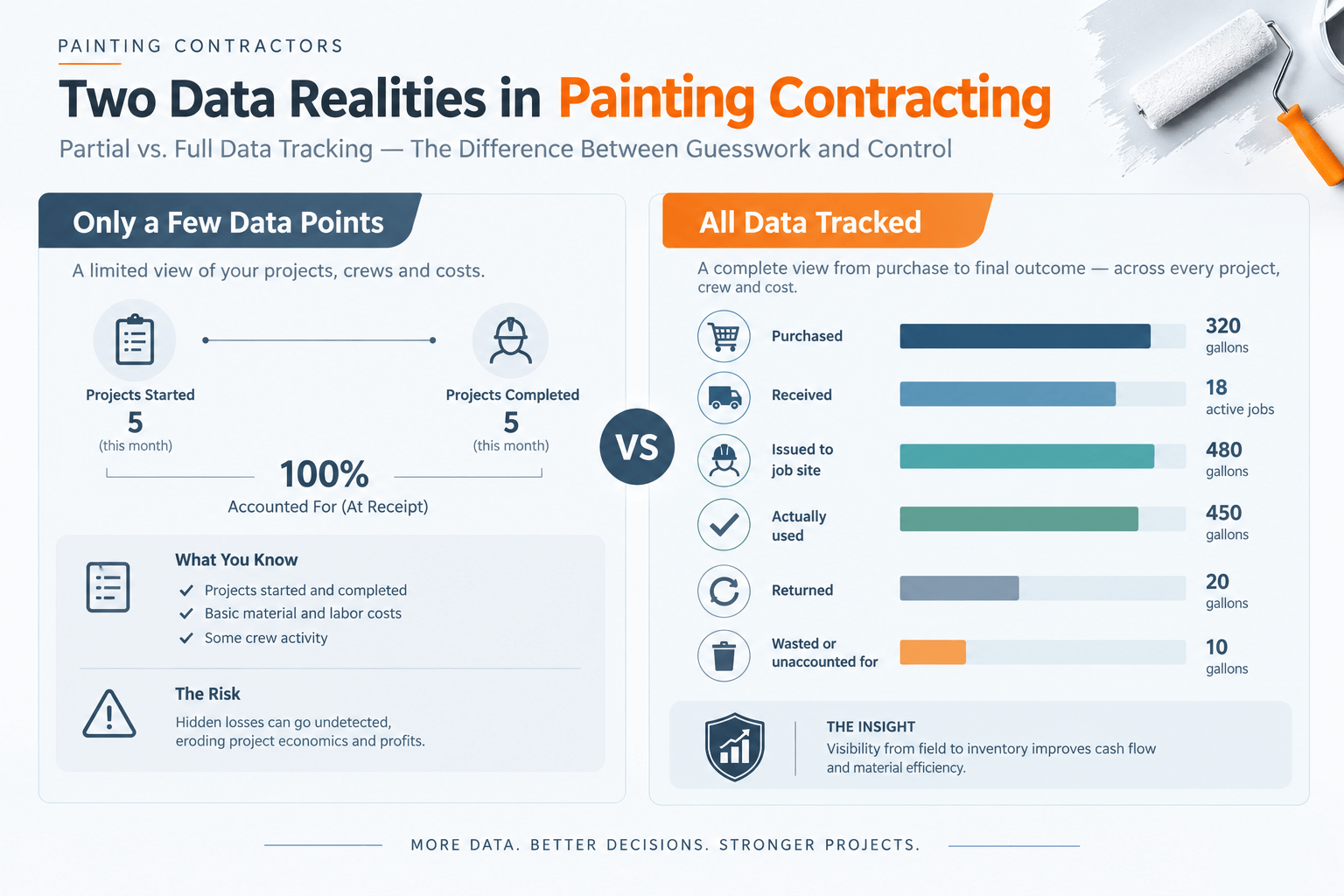
| Stage | Example (gallons) |
|---|---|
| Purchased | 500 |
| Received | 500 |
| Issued to job site | 480 |
| Actually used | 450 |
| Returned | 20 |
| Wasted or unaccounted for | 10 |
If you only track the first two rows, a project can look fine on paper while quietly losing money on the ground. And the risk here is not small. Research from the Indiana IDEM, P2 Toolkit found that most spray application does not go above 50 percent transfer efficiency, and typically lands closer to 30 to 40 percent. That means well over half the material sprayed can be lost as overspray instead of building the dry film thickness the spec called for. Separately, the Pennsylvania DEP, Construction Waste have found that up to 30 percent of building materials delivered to a typical job site can end up as waste, and disposing of that waste can cost up to 6 percent of the total project cost on its own.
None of that shows up in a system that only tracks what was bought and what is sitting in the yard. It only becomes visible once usage is recorded by crew, by project, and by work order, including what the foreman issued, what came back on the truck, and what got wasted on a bad mix or a rained-out day. Ideally, this happens through simple mobile updates from the field, not an end-of-week guess written on a sticky note. This is exactly the layer most inventory tools never reach, and it is where a connected material management system earns its keep, turning that end-of-week guess into a number the field can log in seconds.
From Consumption to Cost: Measuring Material Variance and Project Profitability
This is where material management stops being an operations topic and becomes a leadership one.
Once you can compare estimated, purchased, and used quantities against actual cost, three types of variance become visible:
- Quantity variance: did the project use more or less material than estimated?
- Price variance: did the company pay more or less than the estimated price?
- Cost variance: how far off was actual material cost from the project budget overall?
A study in the peer-reviewed journal Acta Structilia, 2021 looked at material management on real construction sites and found that poor material management had a measurable negative effect on waste, work quality, and project profit. This is not a theoretical risk. It has been documented on real job sites.
Here is a simple example. A project was estimated to spend $30,000 on materials. Actual material costs come in at $36,000. That $6,000 gap needs an explanation, and it could come from several places: higher supplier prices, a bad takeoff, excess use, a rework or callback, waste, or a scope change the office never priced in.
Without variance data broken down by type, a contractor can only guess which one it was. With it, material management becomes a real decision-making tool instead of a background task. Getting there means estimate, purchase, and usage data need to live in one connected system instead of three disconnected ones, which is exactly what the rest of this article covers.
What Material Management Software Should Help Painting Contractors Control
Every gap covered so far, the takeoff done by rule of thumb, the Thursday-afternoon rush order, the 40 gallons of primer nobody logged, the sticky-note usage guess, the $6,000 variance nobody could explain, traces back to the same root cause. No single system connects the stages of the material journey, so each gap gets discovered on its own, usually after it has already cost something.
That is what a material management system actually needs to fix. Not a longer feature list, but one connected view across five outcomes that actually matter to the business.
1. Procurement control
This turns a takeoff into a purchase requisition and a purchase order without losing the numbers in between, keeps supplier pricing on hand for comparison, and routes everything through whatever approval steps a GC or owner requires. It is also the layer that would have stopped the Thursday-afternoon rush order, since a system that can see upcoming material needs across every active project can flag a shortage days in advance, instead of the field finding out the hard way.
2. Inventory control
This tracks material across every yard and job site at once, not just one location, with real-time availability instead of a count that is already a week out of date. It handles reservations, so material earmarked for one project cannot get quietly pulled for another, transfers when material needs to move between sites, and batch or lot tracking so a color match holds up across different production runs. This is the exact layer that would have caught the 40 leftover gallons of primer before a second superintendent placed a duplicate order.
3. Field control
This lets crews request material from the yard, get it issued against a specific project, and record what was actually applied, returned, or wasted, ideally from a phone on the job site rather than a notebook transcribed a week later. This is the layer that turns the sticky-note guess into a number the office can trust the same day.
4. Cost control
This compares estimated versus actual material cost, breaks usage variance down by type, and rolls all of it up into project-level job costing. This is what would have turned the $6,000 gap between a $30,000 estimate and a $36,000 actual cost from a mystery into an explained line item, quantity variance, price variance, or something else entirely.
5. Management visibility
This rolls material spend, inventory value, usage trends, waste, variance, and project profitability up across every active project into one place, built for a CXO or director rather than a foreman or buyer. Nobody has to call the yard or chase down a spreadsheet to get an answer that should already be sitting on a dashboard.
For a quick side-by-side reference, here is the same breakdown in table form:
| Business Outcome | What the Software Does |
|---|---|
| Procurement control | Material takeoffs, purchase requisitions, purchase orders, supplier pricing, approval steps |
| Inventory control | Multi-location inventory across yards and sites, reservations, transfers, batch or lot tracking for color match, real-time availability |
| Field control | Job-site material requests, material issue to crews, usage recording, returns, waste tracking, mobile access from the field |
| Cost control | Estimated versus actual material cost, usage variance, project-level material cost, job costing |
| Management visibility | Material spend, inventory value, usage trends, waste, variance, project profitability |
Seen this way, none of these are features for their own sake. Each row closes a specific gap already covered earlier in this article, and together they are the difference between finding out what a project cost after it is done and knowing it while there is still time to act.
Material Management Software vs. Standalone Inventory Software vs. ERP
These three approaches sound similar, and vendors often blur the lines between them, but they actually answer three different questions.
Standalone inventory software asks: how much material do we have?
This tier tracks stock counts, usually at a single location. It can tell you how many gallons of primer are sitting in the yard right now, but it has no idea which project that primer is meant for, whether a crew is applying an identical batch 40 miles away at that same moment, or what the original takeoff assumed it would cost. This is roughly where most contractors already are, whether they call it software or a spreadsheet.
Material management software asks: where is the material, which project is using it, and how much has been used?
This tier follows material across every yard and job site and ties it to a specific project. It is the layer that would have caught the 40 leftover gallons of primer before a second superintendent reordered it, and the same layer that turns job-site usage into a real number instead of an end-of-week guess. Very few contractors have this piece in place, and it is the one most of this article has been building toward.
An integrated ERP for Painting Contractors asks: how is material buying and use affecting the cost and profit of the entire project?
This tier connects material data to job costing, accounting, and scheduling, so a $6,000 variance does not just sit in an inventory report. It shows up as a real, current line item against that specific project’s profitability, visible to the office before the punch list closes, not after. Almost no painting or coating contractor has this fully connected end to end, and it is usually the last piece built, not the first.
| Layer | Question It Answers | What It Typically Misses |
|---|---|---|
| Standalone inventory software | How much material do we have? | Which project the material belongs to, what it costs against budget, whether it is even at the right site |
| Material management software | Where is the material, and how much has been used? | How that usage is affecting overall job cost and company-wide profitability |
| Integrated ERP | How is material affecting the cost and profit of the entire project? | Nothing structurally, though it depends on accurate data flowing in from the two layers below it |
Most contractors already have some version of the first layer. Very few have the second layer connected to real job data. Almost none have the third layer tied together end to end. The bigger a contractor’s project volume grows, the more that gap starts to show up directly in the bottom line, and the more expensive each unexplained variance becomes.
When Is It Time to Move Beyond Spreadsheets and Disconnected Systems?
Every gap covered in this article starts out as a small, forgivable habit. It only becomes a real cost once it repeats across enough projects to add up. The checklist below groups those habits by where they show up, so you can see where your organization actually stands today, not where you assume it stands.
Procurement
- Buying is often reactive instead of planned, driven by a phone call from the field instead of visibility into upcoming need.
- Emergency runs to the supply house happen often enough to be a pattern, not an exception.
Yard and warehouse
- Job-site and yard inventory are hard to track accurately across more than one active project.
- Leftover material and unused drums regularly sit at completed job sites, uncounted and unused.
Job site
- Material use is reported by hand, inconsistently, or after the fact, instead of recorded in real time.
- Project managers do not have reliable, real-time visibility into what is actually on-site.
Cost and reporting
- Actual material costs are only discovered once the punch list is closed out, not while there is still time to act.
- Management cannot clearly explain material cost overruns when a GC or owner asks.
- The office and the field keep different, conflicting versions of material data.
- Growing project volume is making the current process harder to manage, not easier.
Count how many of these describe your organization today.
- 1 to 2: early signs worth watching, but likely not costing real margin yet.
- 3 to 5: material management is very likely already costing your organization margin, even if it never shows up as a clean line item.
- 6 or more: this is not an occasional problem. It is the normal way the business runs, and the cost is compounding with every project.
See What Your Material Costs Are Really Doing to Project Margin
Most contractors do not lose money at the purchase order. They lose it in the gap between what got issued off the truck and what actually went on the wall.
Talk to our team about connecting takeoffs, procurement, jobsite usage, and job costing into one system.
Building a Connected Material Management Process
The pieces covered so far, estimating, buying, warehouse visibility, job-site use, and variance reporting, only deliver their full value once they are connected into one workflow instead of managed as separate tools:
Estimate → Material Requirement → Procurement → Receiving → Warehouse → Project Allocation → Job-Site Use → Returns and Waste → Actual Job Cost → Project Profitability
The real value does not come from automating any single step on its own. It comes from connecting all of them, so a number entered at the estimate stage can be traced all the way through to its effect on final project margin. This is also where an integrated ERP earns its place, not as a separate purchase decision, but as the connective layer that makes the rest of this workflow actually work together.
Conclusion: Better Material Control Means Better Project Control
Material management is not about knowing how many gallons of paint are sitting in the yard. It is about knowing what was planned, what was bought, what was delivered, where it went, what got applied, what was wasted or returned, what it actually cost, and how all of that affected the project’s margin.
Better material visibility leads to better cost control. Better cost control leads to better project profit. For painting and coating contractors working on tight material margins, that connection is not optional. It is the job.