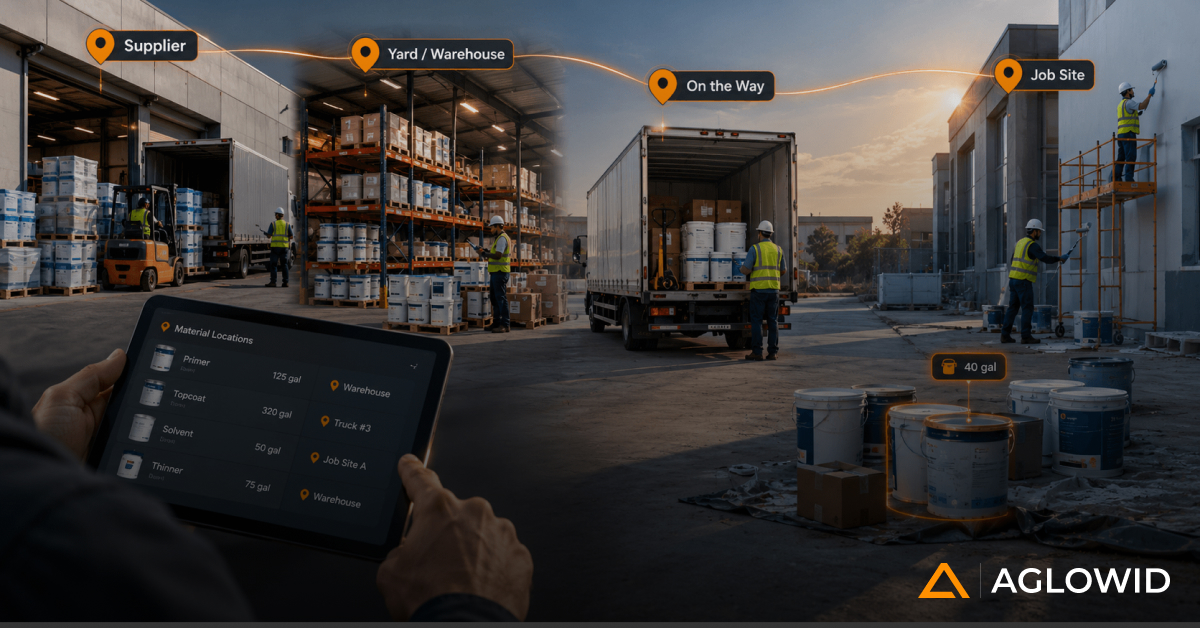
For decades, ERP systems have excelled at recording transactions. The next generation of ERP will do something far more valuable: understand the business context behind every decision.
Your ERP Is Excellent at Remembering. It Is Terrible at Understanding.
A mid size contracting company closes out a job and the numbers land on a manager’s desk. Project margin: 14 percent. Budgeted margin: 22 percent.
The ERP flagged it correctly. The number is right there, timestamped, tied to the job code, sitting in a clean report. Nobody disputes it.
But the report cannot answer the one question the manager actually needs answered: why did this happen?
This scene repeats itself in some form in almost every company that runs on ERP. Revenue drops in a region and nobody can say why without a week of digging. A job blows through its budget and the explanation lives in someone’s memory, not in the system. Inventory quietly climbs for months before anyone notices the pattern. A customer complains and the account history shows what was ordered, not what went wrong in the relationship. A supplier delays a delivery and the purchase order shows the new date, not the reason operations had to scramble.
Your ERP recorded every one of those events. It just never captured why they happened.
Most companies believe their ERP knows the business. It does not. It only knows the transactions.
And that single question, why, is becoming the most valuable capability in modern ERP implementation.
ERP Has Evolved Before. It Is About to Evolve Again.
It helps to remember that ERP was not always this good at recording transactions either.
Businesses once ran on paper, and the knowledge of how things actually worked lived inside a handful of people’s heads. That created errors, delays, and almost no visibility beyond whoever happened to remember correctly. Then came spreadsheets, which digitized everything but solved nothing structurally. Every department built its own version of the truth, and reconciling those versions became a monthly ritual. ERP arrived as the fix: a single source of truth, integrated departments, standardized processes, and a genuine productivity leap that most businesses running today still benefit from.
Then automation layered on top of that foundation. Workflow approvals routed themselves. Notifications fired automatically. Scheduling, procurement, and accounting tasks that used to require a person now happened on rules. This reduced manual work significantly, but it was still fundamentally rule based. If X happens, do Y. The system still had no concept of why X happened in the first place.
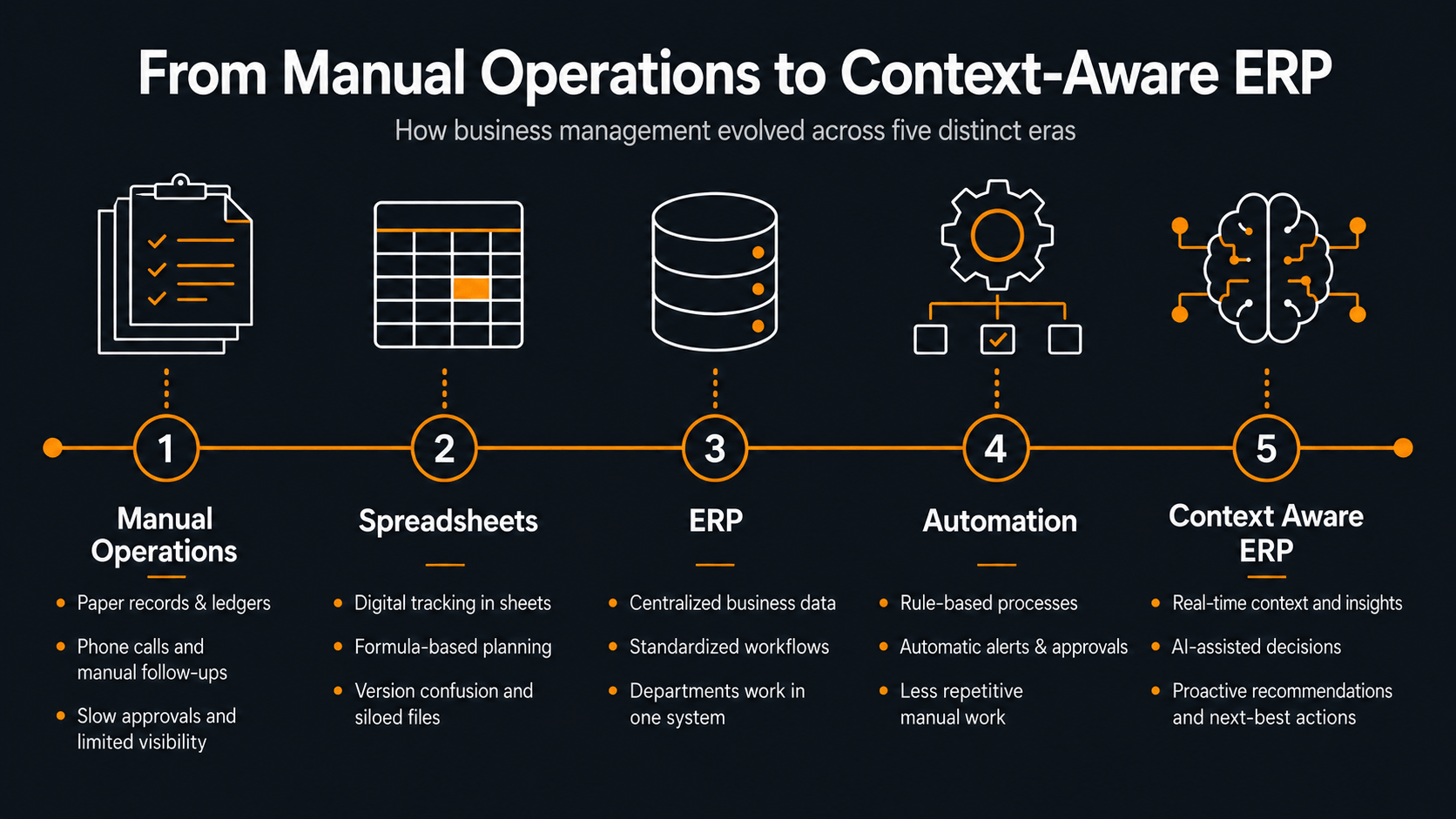
That is the gap the next era closes. Context aware ERP does not just automate what happens next. It starts to understand what caused what came before. This is not a replacement of everything that came before it. It is the layer that was always missing, and it is not theoretical. It is showing up across the entire ERP market at once. Odoo shipped its first native AI Agents and a natural language “Ask Odoo” search layer in version 19 in late 2025. SAP’s Joule assistant has moved from a question answering copilot into an agentic platform embedded across S/4HANA, BTP, and SuccessFactors, reasoning across dependencies rather than just surfacing dashboards. And Microsoft’s 2026 release wave embedded autonomous agents across Dynamics 365 Finance, Supply Chain, Sales, and Business Central, moving Copilot from a reactive chat assistant toward something that executes multi step business processes on its own. Whatever ERP a business runs, this same shift is already showing up on vendor roadmaps, not just in theory pieces like this one.
ERP Became the Company’s Memory. It Was Never Built to Explain Itself.
Before pointing at what is missing, it is worth appreciating what ERP already does exceptionally well.
Every invoice. Every purchase order. Every payroll run. Every unit of inventory, every production order, every CRM interaction, every project milestone, every timesheet entry, every expense report. All of it becomes structured, searchable, permanent data. That is not a small achievement. Before ERP, most of that information lived in filing cabinets, personal notebooks, or nowhere at all.
An ERP is like an incredibly disciplined accountant. It never forgets a transaction, never misplaces a record, never lets a number quietly disappear. But it does not understand the story behind the number. It was never built to.
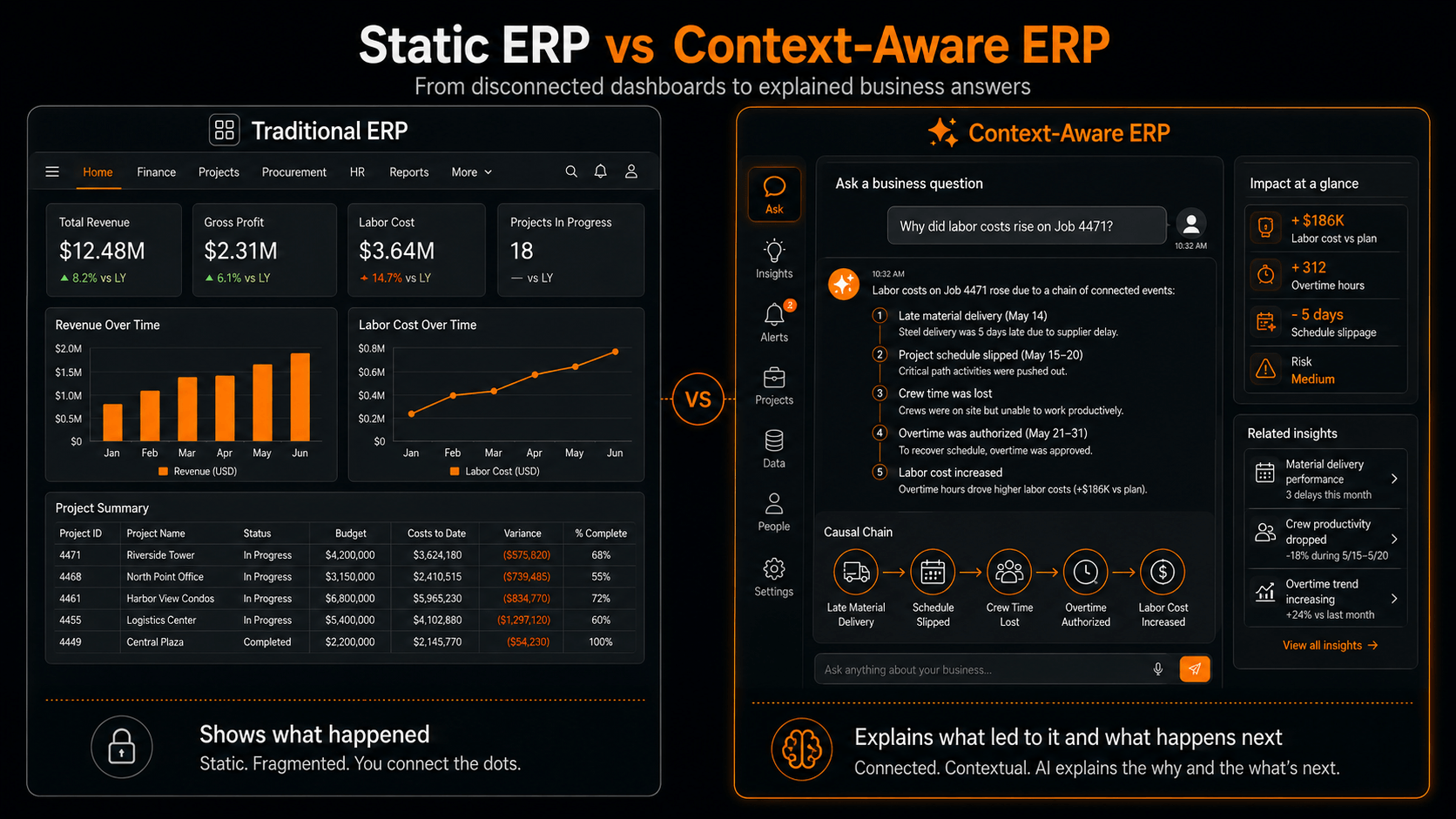
Go back to the contracting company. The manager pulls up the job. Project margin: 14 percent, against a budget of 22 percent. The manager asks the obvious question: why?
The system offers one layer deeper. Labor cost increased by 31 percent over budget.
The manager asks again: why did labor cost increase?
And here the system goes quiet. It has nothing further to say. The data simply stops.
So the manager starts investigating the old fashioned way. Emails get reread. Phone calls get made to the site supervisor. A meeting gets scheduled. Someone digs through a spreadsheet the foreman kept on the side because the ERP did not have a field for what he needed to track. Eventually, after a few hours or a few days, the picture comes together: a key material shipment arrived twelve days late, the crew sat partially idle waiting for it, and once it finally arrived the team worked overtime to hit the deadline anyway. That overtime is what blew the labor line.
None of that reasoning exists anywhere inside the ERP. It exists in emails, in someone’s memory, and in a side spreadsheet that will probably be deleted next quarter. This is where real decision making still happens in most companies today, entirely invisible to the system that is supposed to be the single source of truth.
The ERP told the manager exactly what happened. It took three separate humans and half a week to figure out why.
Business Context Is the Most Valuable Data Your ERP Never Captures
Context is not another database to buy or another module to license. Context is understanding the relationship between events that a traditional ERP stores as if they were unrelated.
Follow the contracting company’s story as a chain rather than a single data point:
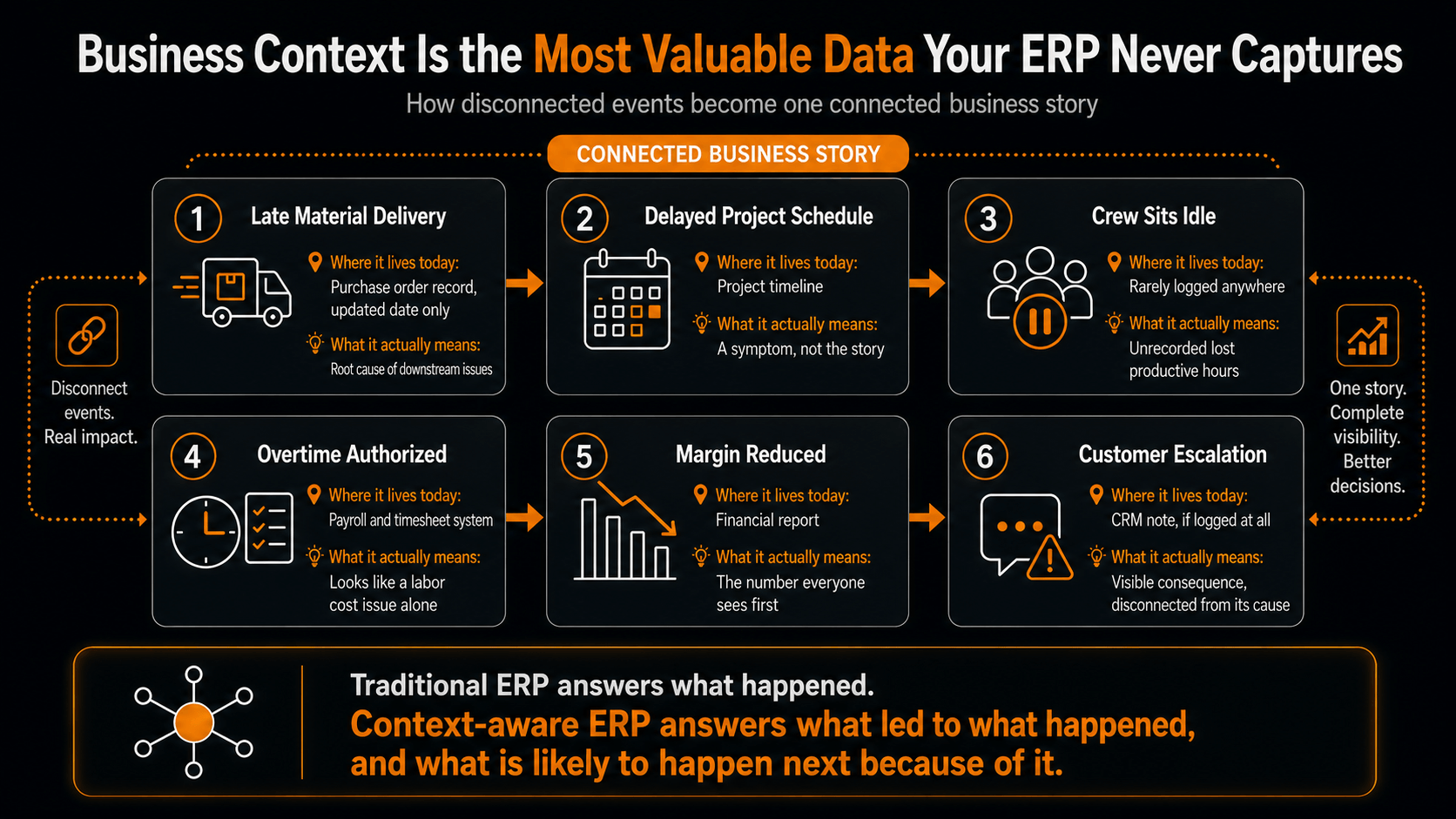
| Event | Where It Lives Today | What It Actually Means |
|---|---|---|
| Late material delivery | Purchase order record, new date only | The root cause of everything downstream |
| Delayed project schedule | Project timeline, shows the slip, not the cause | A symptom, not the story |
| Crew sits idle | Nowhere. Rarely logged as its own event | Lost productive hours, unrecorded |
| Overtime authorized | Payroll and timesheet system | Looks like a labor cost problem on its own |
| Margin reduced | Financial report | The number everyone sees first |
| Customer escalation | CRM note, if anyone logs it at all | The visible consequence, disconnected from its cause |
Six separate systems, or six separate corners of the same system, each holding one fragment. A traditional ERP stores each of these as an isolated record with no thread connecting them. AI is what ties them into one coherent business story: the late delivery caused the idle crew, the idle crew forced the overtime, the overtime ate the margin, and the margin loss eventually surfaced as a customer complaint nobody initially connected back to a supplier’s delivery schedule.
This is what context actually looks like in practical terms, not an abstract idea, but a specific set of inputs most ERPs never capture systematically today: the approval note attached to an exception, the internal message thread tied to a delayed purchase order, the reason field a manager fills in (or more often, skips) when overriding a schedule, and timestamps around decisions rather than just timestamps around transactions.
Traditional ERP answers what happened. Context aware ERP answers what led to what happened, and what is likely to happen next because of it.
The same chain shows up in other industries wearing different clothes. A manufacturer sees a quality rejection rate spike on a production line. The ERP shows the defect count. It does not show that the spike started two shifts after a new supplier’s raw material batch entered the line, because the supplier change and the quality data live in two systems that were never connected. A service business sees a customer churn a contract. The CRM shows the cancellation date. It does not show that the same customer submitted three support tickets in the prior month that never got escalated past a junior technician. In every case, the individual facts were captured somewhere. The story connecting them was not, and the story is the only part that actually explains what to do differently next time.
ERP Is the Memory. AI Becomes the Reasoning Layer.
How Agentic AI Actually Works Inside an ERP System
There is a common misconception worth correcting directly: AI is not here to replace ERP. It is here to complete it.
ERP remains the system of record. It still owns the transactions, the compliance trail, the financial accuracy that a business is legally and operationally required to maintain. AI does not touch that foundation. What it adds sits on top of it.
| Traditional ERP | AI Enabled ERP |
|---|---|
| Records transactions | Explains outcomes |
| Executes workflows | Understands patterns |
| Shows dashboards | Answers questions |
| Stores data | Connects knowledge |
| Follows rules | Learns from experience |
In practice this shows up in a few concrete ways. AI explains why a number moved instead of just reporting that it moved. It predicts which projects are trending toward risk before the margin actually erodes. It recommends specific next steps grounded in what has worked in similar situations before. And it assists a manager through the investigation itself, surfacing the delayed purchase order and the idle crew hours automatically instead of requiring three phone calls to reconstruct.
This is not a distant vision. Odoo’s 19.1 update, released in January 2026, added context aware filtering that understands time periods, departments, and data relationships, along with early multi step task chaining rather than single question, single answer responses. On the enterprise end of the market, SAP now describes Joule as running more than 40 specialized agents across finance, procurement, and supply chain, each one designed to reason, plan, and act with minimal step by step human input rather than simply answer a question when asked. Both are early, still developing versions of exactly the reasoning layer described above: a system that starts connecting records instead of just displaying them. The direction is clear even if the maturity varies by platform and by how disciplined the underlying data already is.
This is also where the old idea of clicking through dashboards starts to give way to something more direct. Instead of navigating five reports to find the labor variance, a manager can ask why labor costs are rising on a specific job, or which projects are becoming risky this month, and get an answer grounded in the actual chain of cause and effect the system has connected. That only works because of the context layer described above. A conversational interface bolted onto a system with no connected reasoning underneath it is just a chatbot reading dashboards out loud. The value is in the connection, not the interface.
None of this replaces the manager’s judgment. It changes what the manager has to manually dig for versus what already shows up connected and explained.
It is also worth being honest about the limits here. An AI generated explanation is a hypothesis built from patterns in the data, not a verified fact. It can be wrong, incomplete, or confidently stated when the underlying data was thin to begin with. According to Gartner’s research on cloud ERP adoption, over 40 percent of agentic AI projects are expected to be canceled by 2027, largely due to unclear ROI and weak risk controls, a signal that plenty of organizations are deploying these systems faster than they are governing them. The sensible posture is to treat AI generated reasoning the way you would treat a sharp junior analyst’s first draft: useful, often right, but worth a second look before it drives a real decision.
The Knowledge That Walks Out the Door Every Evening
This is the part of the story most ERP and AI content never talks about, and it may be the most consequential one for a growing business.
Every day, managers make dozens of judgment calls that never get recorded anywhere. A manager approves a change order without escalating it. A manager rejects a supplier’s proposal because something about the terms felt off, based on three prior jobs with that supplier. A manager reallocates a crew mid week because they sensed a schedule risk before it showed up in any report. A manager overrides a system recommendation because local knowledge said the recommendation was wrong for this specific site.
None of that reasoning gets stored. The ERP captures the outcome (a purchase order changed, a task got reassigned) but never the why behind the decision.
Eventually, that manager retires, gets promoted, or leaves for a competitor. According to a 2024 Deloitte analysis cited by Atlan, voluntary turnover among knowledge workers costs the broader US economy an estimated $1.3 trillion annually, with knowledge loss representing the single largest share of that figure, and the average knowledge worker now stays in a role for only about 4.1 years. Separate research summarized by Market Logic puts the replacement cost of losing a single experienced employee as high as 213 percent of that person’s salary, largely because it can take up to two years for a new hire to reach the same level of judgment and efficiency as the person they replaced.
The ERP still has every transaction that manager ever touched. It never had the reasoning behind a single one of them.
The system remembers what the manager did. It never learned why the manager did it, which is the part that actually made them good at the job.
A context aware ERP changes this by capturing reasoning at the moment a decision is made, not after the fact. When a manager overrides a recommendation, the system asks for and stores the reason in a structured way. When a manager approves an exception, the context behind it becomes part of the permanent record, searchable and usable long after that manager has moved on. This does not replace institutional judgment. It is the first real attempt to keep some of it inside the company after the person who built it walks out the door.
Garbage In. Artificial Intelligence Out.
None of the reasoning described above is possible if the data underneath it is a mess, and for most companies today, it still is.
Poor data quality is not a minor operational annoyance. According to Gartner research, poor data quality costs the average organization an estimated $12.9 million per year, a figure that predates the current AI push and has only become more consequential as companies try to layer reasoning on top of that same flawed data. A more recent 2025 IBM Institute for Business Value study found that 43 percent of chief operations officers now identify data quality as their single biggest data priority, and over a quarter of organizations surveyed estimated they lose more than 5 million US dollars annually because of it, with 7 percent reporting losses above 25 million.
The common culprits will sound familiar to anyone who has worked inside an ERP for more than a few months: duplicate customer records, missing units of measure, bills of materials that were accurate two years ago and never updated, disconnected spreadsheets that quietly became the real source of truth for one department, timesheets filled in three days late from memory, project updates that stopped happening once a job got busy, and naming conventions that differ depending on who set up the record.
AI cannot reason its way around chaos like this. It can only find patterns in the data it is given, and if that data is duplicated, incomplete, or inconsistent, the patterns it finds will be duplicated, incomplete, and inconsistent too. No amount of AI sophistication fixes a foundation that was never built to explain itself in the first place.
This is also why so many AI pilots stall out quietly rather than fail loudly. A company connects an AI layer to its ERP expecting sharper insight and instead gets confident sounding answers built on the same duplicate vendor records and inconsistent job codes that have been quietly wrong for years. Nobody notices immediately, because the answer looks polished. The problem surfaces weeks later when a decision made on that answer does not hold up. At that point the instinct is often to blame the AI, when the actual issue was sitting in the master data the whole time, untouched and unquestioned long before anyone talked about adding intelligence on top of it.
<blockquote>An AI system layered on top of bad ERP data does not produce bad answers slowly. It produces confident, well formatted, wrong answers quickly, which is arguably worse.</blockquote>
The Best AI Will Not Replace Managers. It Will Make Them Better Managers.
There is an understandable fear sitting underneath a lot of this conversation: if the system can explain why margin dropped and recommend what to do about it, what is left for the manager to actually decide?
The honest answer is that AI does not replace judgment. It improves the information judgment is built on.
In practice, this looks like risks getting flagged two weeks before they would have surfaced in a normal end of month report. It looks like recommendations grounded in what actually happened on similar jobs before, rather than a generic best practice pulled from a textbook. It looks like trends surfacing that nobody was manually tracking, because no human has the bandwidth to watch forty active projects for subtle pattern shifts at once. It looks like delays getting predicted before they compound into a full blown schedule crisis. It looks like anomalies getting explained instead of just flagged, so the manager spends their time deciding what to do rather than figuring out what happened.
The manager still decides whether to authorize the overtime, whether to switch suppliers, whether to escalate to the client. The system got smarter about what it hands the manager before that decision gets made. The decision itself never moved.
It helps to think of this the way an experienced pilot thinks about a modern cockpit. The instruments do far more work today than they did fifty years ago. They calculate, they warn, they even suggest. Nobody argues the pilot has become less important because of it. The pilot became more effective because the noise got filtered out and the signal got clearer. That is the honest version of what augmentation looks like inside an ERP. Not a system quietly taking over decisions, but a system removing the hours of manual digging that used to stand between a manager and a good decision.
There is also a quieter benefit worth naming directly. Newer managers get better faster. A manager two years into the role, working inside a context aware ERP, has access to the same connected reasoning that took a twenty year veteran a career to build intuitively. That does not make the newer manager equally experienced. It does mean the gap between a new manager’s decisions and a veteran’s decisions starts to narrow sooner, which matters enormously for companies that are growing faster than they can promote from within.
Preparing Your ERP for the AI Era Starts Long Before You Deploy AI
An ERP Data Readiness Checklist for AI Adoption
Given everything above, the practical next step for most companies is not to buy an AI module. It is to prepare the ground it will stand on.
Process. – Standardize workflows across departments and locations before asking a system to reason across them. Inconsistent processes produce inconsistent data, and inconsistent data produces unreliable AI output.
Data. – Clean master data first. Duplicate vendors, inconsistent naming, and missing fields will undermine any AI initiative before it starts, regardless of how good the underlying model is.
Users. – Increase genuine ERP adoption. A system that half the team works around with personal spreadsheets cannot generate a trustworthy picture of what is actually happening in the business.
Integration. – Connect the systems that currently operate in isolation. Context cannot form across a gap between two platforms that never talk to each other.
Governance. – Define clear ownership over data and over decisions. Someone needs to be accountable for data quality the same way someone is accountable for financial accuracy.
Context. – Start capturing reasons, not just transactions. This is the item most companies skip entirely, and it is the one described earlier: approval notes, exception explanations, and the reasoning behind overrides. Every one of these, captured consistently starting today, becomes the training ground for a genuinely useful AI layer tomorrow.
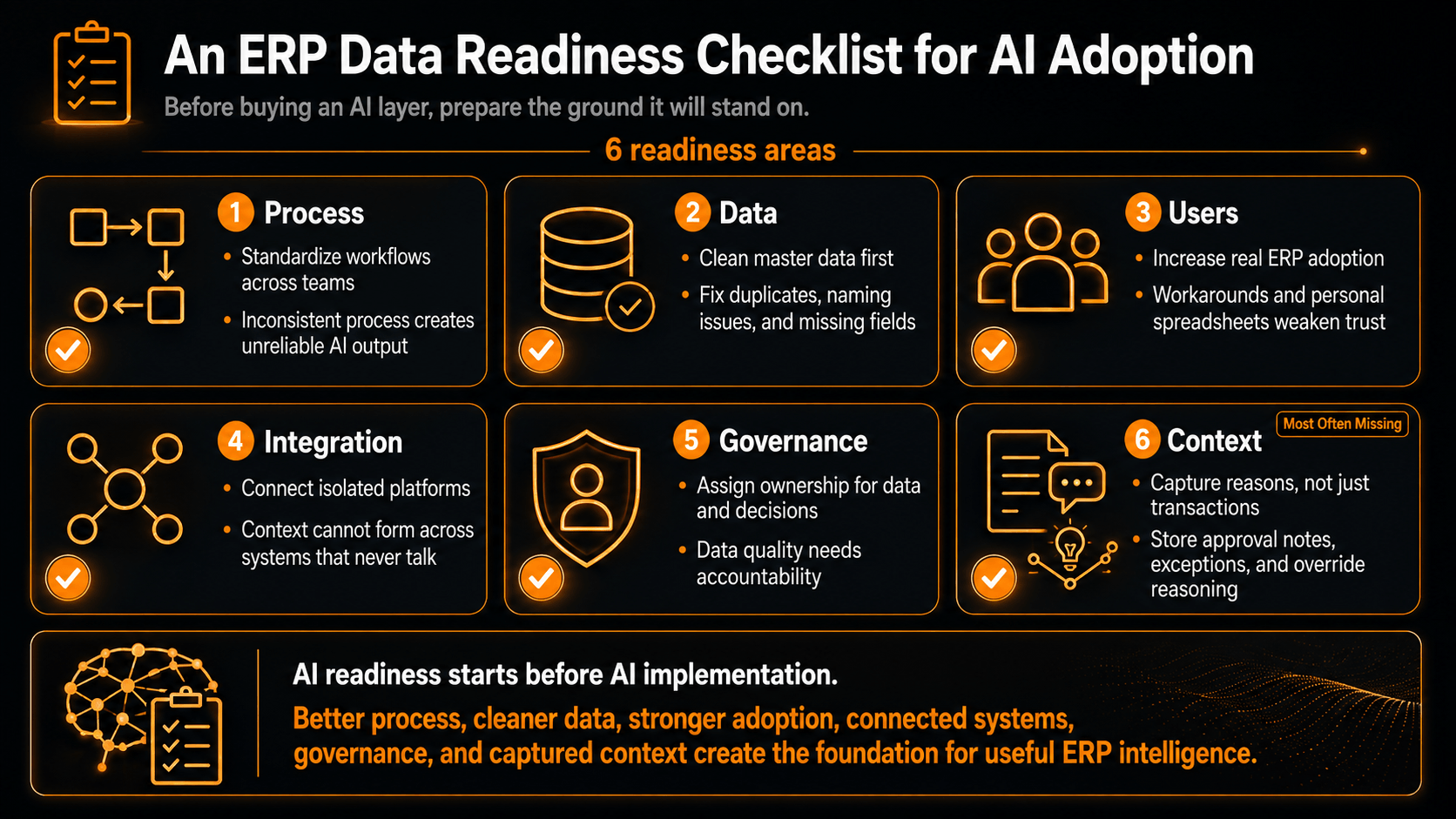
None of these six items require buying anything new. They require discipline that most companies have been putting off for years, and they are the actual determinant of whether an AI investment pays off or quietly fails within eighteen months. This is worth taking seriously on a timeline, not just in principle. Odoo’s own roadmap points to version 20, expected around September 2026, pushing further into agentic workflows that execute multi step actions with less human prompting than the assistive AI agents introduced a year earlier, and Microsoft’s Dynamics 365 Business Central has been described in its own release notes as explicitly designed to accelerate the move to agentic ERP. Whatever platform a company runs, from open source to the largest enterprise suites, the pattern is the same: the vendors are moving toward autonomous execution faster than most internal data and process discipline is ready for it. Getting the foundation right now is what determines whether that autonomy gets pointed at good decisions or bad ones. Gartner’s own forecast on cloud ERP suggests the market already sees this shift coming: AI enabled solutions are expected to account for 62 percent of cloud ERP spending by 2027, up from just 14 percent in 2024. The companies that spend that money well will be the ones who did this groundwork first.
Every idea in this article traces back to one line: ERP remembers, but it was never built to explain. Context is the missing layer that turns disconnected records into a coherent story, and AI is what supplies the reasoning on top of it. None of it works without a clean, disciplined foundation underneath.
The Competitive Advantage Will Not Be AI. It Will Be Context.
Over the past decade, businesses largely competed on who collected more data. Whoever had the most complete CRM, the most detailed project history, the most granular financial reporting had an edge.
Over the next decade, the competition shifts. It will be about who understands that data better, not who simply has more of it. Research from McKinsey has consistently shown that knowledge workers spend roughly 20 percent of their workweek, close to a full working day, searching for and gathering information rather than acting on it. That is not a technology problem in the way most people assume. It is a context problem. The information usually exists somewhere in the business. It is just scattered, disconnected, and unexplained.
The companies that win this next stretch will not necessarily have the biggest AI budget. Enterprise AI spending is real and growing fast, with global spending projected to surpass 300 billion US dollars in 2026 alone, but budget size has never been the differentiator that actually matters in operations. The companies that win will have better processes, cleaner data, genuine adoption, and real operational discipline, because those four things are what create usable context in the first place.
Picture the same contracting company again, but this time it spent the last year doing the unglamorous work: cleaning master data, standardizing how exceptions get logged, connecting procurement to scheduling, and requiring a one line reason field on every override. The same late shipment happens. The same crew sits partially idle. But this time, the connection between the delayed material and the coming margin hit surfaces the same day, not three weeks later, because the system already understands how these events relate to each other. The manager gets to make the call on overtime, alternate suppliers, or a client conversation while there is still time to change the outcome, instead of discovering the full story after the job is already closed and the damage is already done.
That gap, between finding out on day one versus finding out three weeks later, is the entire competitive advantage this article has been describing.
None of this requires a company to be large to benefit from it either. A twenty person contracting business or a fifty person manufacturer can build this same discipline without an enterprise budget. What it requires is a decision, made at the leadership level, that context capture is now part of how the business runs, not an optional add on for whenever the AI project eventually gets approved. The businesses that treat this as a leadership priority today, rather than a future IT initiative, are the ones that will find AI genuinely useful the moment they adopt it, instead of spending a year discovering that their data was never ready for it.
Your ERP Already Knows Your Business. The Next Question Is Whether It Can Understand It.
Most organizations believe their digital transformation ends once ERP is implemented. In reality, ERP implementation is only the beginning.
The next transformation is not about capturing more transactions. Most companies already capture plenty. It is about helping every decision become faster, smarter, and better informed by the transactions that are already sitting there, unconnected.
The future of ERP is not simply becoming more automated. It is becoming more aware.
Is Your ERP Ready for the AI Era?
AI does not begin with a chatbot or a new software module. It begins with the quality of your processes, the discipline of your data, and the context your ERP captures every single day.
If your ERP is still operating purely as a system of record, now is the time to start preparing it to become a system of understanding.