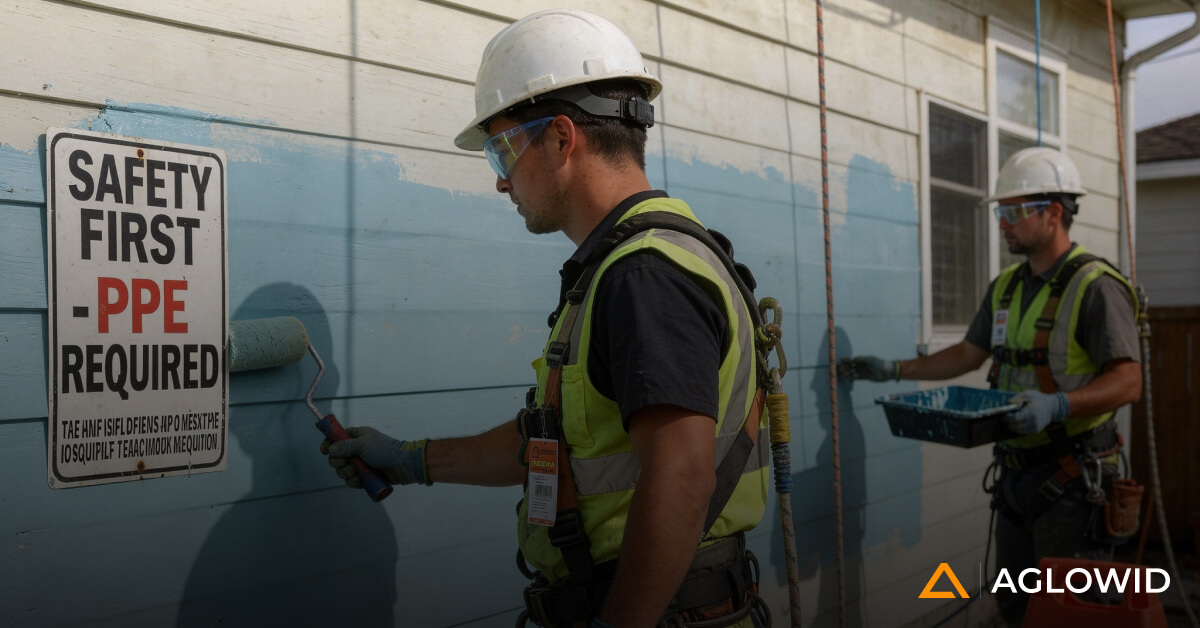
Real-World Scenario
A commercial painting contractor bids on a $1.8 million healthcare facility repainting contract. They have the crew. They have the experience. They do not get the contract. The reason: their OSHA training records were scattered across two binders and a shared drive folder, and they could not produce a clean compliance package within the client’s 48-hour documentation window. The contract went to a smaller competitor who had their records in one system.
That scenario is not hypothetical. It plays out across the commercial and industrial painting industry every quarter. And as the projects get larger, as clients move into healthcare, education, manufacturing, and government infrastructure, the compliance requirements compound fast. A missed certification, an expired insurance policy, a payroll violation, or an incomplete safety record does not just create administrative headaches. It costs you the bid before the first coat is applied.
This guide is not about selling you software. It is about helping you understand what compliance risk actually costs a growing painting and coating contracting business, where the gaps come from, and how a Painting Contractors ERP system changes the operational equation for contractors serious about scaling into larger commercial work.
Why Compliance Gets Harder as Your Business Grows
A five-person painting crew operating out of one location has manageable compliance requirements. A company running 60 to 150 employees across multiple states, subcontracting on commercial properties, and bidding on government work faces a fundamentally different compliance environment. The problem is that most companies do not redesign their compliance infrastructure as they grow. They keep adding people and projects to systems that were never built for that volume.
More Employees, More Exposure
Every additional employee added to a payroll brings OSHA training requirements, certification deadlines, wage compliance obligations, and workers’ compensation documentation. When you have 80 employees across four job sites, tracking who has completed their 30-hour OSHA construction training, whose lead-based paint certification expired last month, and whether your overtime records are clean becomes a full-time administrative job. Without a centralized construction management software solution, it becomes a liability.
More Projects, More Regulatory Variables
Operating across state lines means navigating different prevailing wage requirements, different contractor licensing rules, and different VOC (volatile organic compound) emission standards that vary by county in states like California. What passes audit in Texas may trigger a violation review in New York. Manual compliance management across jurisdictions does not scale.
Larger Clients Demand More Documentation
Healthcare systems, school districts, and government agencies do not just want the job done. They want documented proof that the job was done by a compliant, insured, trained, and certified workforce. Pre-qualification checklists for enterprise and public-sector contracts routinely include requests for OSHA incident rates, insurance certificates, certified payroll documentation, and subcontractor compliance records. If you cannot produce these quickly and cleanly, you do not make the approved vendor list.
“24% of organizations across all sizes say that winning new clients is the primary driver behind their compliance investment. For enterprise contracts, that number climbs to 35%.” – A-LIGN 2025 Compliance Benchmark Report
The Real Business Cost of Non-Compliance
Decision makers in painting contracting businesses tend to think about compliance as a regulatory obligation. The more accurate framing is that non-compliance is a business cost that touches every revenue line in your P&L.
The Cost of Getting It Wrong
Global non-compliance penalties hit $14 billion in 2024 across all industries. Research shows the average cost of dealing with non-compliance incidents runs 2.71 times higher than the cost of maintaining a proactive compliance program. For a mid-size painting contractor, the math is straightforward: invest in systems now, or pay multiples later in fines, legal exposure, and lost contracts.
Regulatory Fines and OSHA Exposure
Federal OSHA fines for serious violations reach $16,550 per citation as of January 2025, with willful or repeated violations reaching up to $165,514 per violation. In states like California, serious violation caps are $25,000 per citation. A single inspection that turns up multiple recordkeeping violations, inadequate fall protection documentation, or missing safety training records can generate citation clusters that accumulate rapidly. Painting contractors work at height, handle chemical coatings, and operate in regulated environments. OSHA inspection risk is not theoretical in this trade.
Project Delays and Contract Disputes
When a project is halted because an employee’s certification cannot be verified, the cost is not just the idle crew. It is the delay penalty in the contract, the downstream scheduling disruption for the client, and the reputational mark that follows the bid history of your company in procurement databases.
Lost Bids Before They Even Start
Public-sector contracts and large commercial projects frequently require compliance documentation during the pre-qualification phase, before a single estimate is submitted. If your OSHA incident rate is not documented, if your insurance certificates are expired, or if you cannot produce certified payroll records from prior government work, you are disqualified before the process begins. Every one of those lost pre-qualifications is invisible revenue that never shows up in your pipeline.
The Hidden Cost: Insurance Premiums
Insurers price general liability and workers’ compensation premiums based on documented safety performance. A company with clean, centralized incident records and consistently documented toolbox talks pays materially lower premiums than an identical company whose safety documentation is scattered. Over a five-year period, premium differences compound into significant margin.
| $16,550 Max OSHA fine per serious violation as of Jan 2025 – OSHA.gov, 2025 |
2.71x More expensive to deal with non-compliance than prevent it – AscentRegTech, 2025 |
85% Of companies say compliance has grown more complex in 3 years – Sprinto, 2025 |
The Hidden Cost You Are Not Measuring: Manual Compliance Management
This is the cost that most painting contractors never see clearly because it is embedded in administrative overhead rather than line-item expenses. Consider what manual compliance management actually requires at scale.
- An operations manager or office administrator spending 8 to 15 hours per week tracking certification renewals, pulling insurance certificates, updating payroll records, and preparing documentation for client requests or potential audits.
- A project manager manually reconciling safety inspection reports from three different job sites, then transferring that data into a spreadsheet that another person will eventually compile into a report.
- A payroll administrator correcting certified payroll errors that resulted from manually entering field hours into a system disconnected from the job costing platform.
- An executive spending two hours before a client meeting pulling compliance documentation from four different locations, discovering the day before that two records are missing.
At scale, this is not an administrative inefficiency. It is a structural vulnerability. Every manual handoff between systems is a point where data can be lost, outdated, or incorrect. And when an audit or a pre-qualification request arrives, that vulnerability becomes visible at the worst possible moment.
How ERP Creates Operational Visibility for Compliance
The core value of ERP for compliance management is not automation for automation’s sake. It is the replacement of fragmented data silos with a single operational record that every department works from simultaneously.
In a typical growing painting business without ERP, compliance-relevant data lives in at least five separate locations: an HR system for employee records, a payroll platform, a safety binder or shared drive for OSHA documentation, a separate folder for insurance certificates and licenses, and a project management tool that does not connect to any of the above. When a client requests a compliance package or an auditor arrives, assembling that picture requires hours of work from multiple people pulling from multiple systems.
An ERP consolidates all of this into one platform where employee certifications, insurance documents, licenses, permits, payroll data, safety records, and project documentation are linked to the same employee, project, and client records. A change in one place updates the record across the entire system. An expiring certification triggers an alert automatically. An audit request becomes a report, not a scramble.
What This Looks Like in Practice
A project manager receives a pre-qualification questionnaire from a county government requiring OSHA incident rates, insurance certificates, and certified payroll from three prior government contracts. With a properly configured ERP, this takes 20 minutes to assemble. Without one, it takes the better part of a day and requires input from at least three people, with real risk of submitting outdated or incomplete records.
Key Compliance Areas ERP Manages for Painting Contractors
Workforce and Labor Compliance
|
Workforce and Labor Compliance
|
Safety and OSHA Compliance
|
Contractor Licensing
|
Insurance and Bonding
|
Project Documentation
|
Subcontractor Compliance
|
Check our Success Story
ERP Software for Painting & Coating Contractors
Centralizing Field, Finance, and Compliance with Odoo
Industry: Painting & Coating/Construction
Location: Canada
ERP and Audit Readiness: The Competitive Advantage No One Talks About
Most painting contractors think about audits as something that happens to them. The contractors winning larger commercial and government contracts think about audit readiness as something they build into their operations deliberately, because it is a competitive differentiator during pre-qualification.
When a general contractor or government agency asks for your OSHA incident rate, your last three years of certified payroll, and your current insurance certificates, the speed and cleanliness of your response tells them something about how you run your company. A contractor who responds within the hour with a complete, organized package signals operational maturity. A contractor who responds two days later with a mix of PDFs, spreadsheets, and a note that some records may be at the other office does not win that kind of work.
| Compliance Scenario | Manual / Fragmented Systems | ERP-Managed |
|---|---|---|
| Pre-qualification package request | 1 to 2 days, multiple staff involved, risk of missing records | Under 1 hour, single report pull, complete and current |
| OSHA inspection — document request | Locating records across binders, drives, and email threads | All records in one location, searchable by employee and date |
| Certification expiry management | Manual calendar reminders, frequent misses | Automated alerts 60, 30, and 7 days before expiry |
| Certified payroll for government work | Manually compiled, prone to errors requiring corrections | Auto-generated from payroll and job costing records |
| Client compliance report request | Custom assembly each time, inconsistent formatting | Standardized report templates, consistent output every time |
| Multi-state regulatory differences | Manual tracking per state, often overlooked | Jurisdiction-aware records, flagged by project location |
| Subcontractor insurance verification | Tracked via email and spreadsheet, gaps common | Automated collection workflow with expiry tracking |
Why Compliance is a Revenue Strategy, Not a Legal Obligation
This is the reframe that separates growing painting businesses from plateauing ones. Compliance does not just keep regulators off your back. It directly determines which contracts you can bid, what insurance premiums you pay, and whether enterprise clients see you as a vendor or a partner.
Bid Qualification Becomes a Competitive Moat
Every government contract, every hospital system, and every Fortune 500 facilities team has a vendor approval process. Getting onto an approved vendor list requires compliance documentation. Staying on it requires maintaining that documentation consistently. Contractors with ERP-managed compliance programs can pursue these opportunities. Contractors without them are structurally limited to work that does not require it, which is also the work that is most price-competitive and margin-compressed.
Lower Insurance Premiums Over Time
Workers’ compensation premiums for painting contractors are directly tied to your experience modification rate (EMR), which is a function of your documented incident history. A company with clean, consistent incident documentation and a verifiable safety program earns a lower EMR over time. Over five years, the difference between a 1.4 EMR and a 0.85 EMR in premium costs on a $5M payroll can exceed $200,000 annually. ERP makes the safety documentation that drives that number systematic rather than aspirational.
Contract Eligibility Directly Tied to Documentation Quality
Public-sector and institutional clients increasingly require a minimum OSHA recordable incident rate to bid. They require certified payroll capacity. They require documented safety programs. These are not soft preferences. They are hard pre-qualification gates. ERP positions you to clear those gates consistently.
Do You Know Where Your Compliance Vulnerabilities Are?
Most painting contractors only discover compliance gaps when a bid is lost, an audit arrives, or a project is delayed. A structured assessment takes 30 minutes and maps exactly where your current systems fall short before it costs you a contract.
Assess Your Compliance Gaps Now.
No cost. No commitment. Built for operations leaders in painting and coating contracting.
Commercial and Government Contract Growth: The Compliance Barrier Most Contractors Underestimate
The painting contractors who scale from $3M to $15M in revenue reliably are not the ones who hire the fastest or buy the most equipment. They are the ones who build the operational infrastructure to qualify for, execute, and document commercial and government work at scale. In other words, they treat compliance‑ready ERP as part of a broader contractor digital transformation journey, not just a back‑office software upgrade.
Healthcare facilities have HIPAA-adjacent security requirements for vendors, strict safety protocols for occupied building work, and zero tolerance for an unverified crew member on site. School districts require background checks, lead paint certifications, and documented low-VOC coating compliance for occupied facility work. Government infrastructure projects require Davis-Bacon certified payroll, prevailing wage compliance, and detailed subcontractor documentation.
Each of these client types represents significantly higher contract values and significantly lower price competition than residential or light commercial work. They also require a compliance infrastructure that most sub-$5M painting businesses do not have, not because they are not capable of the work, but because they have not built the operational systems to document it.
“The painting contractors winning the largest institutional and government work are not just better painters. They are better-organized businesses. The compliance infrastructure that ERP provides is what makes that organization scalable.”
ERP provides the repeatable process backbone that allows you to meet these requirements consistently across every project and every client. When you can produce the same quality of compliance documentation on project number 40 as you did on project number 4, you become a contractor that institutional clients trust with long-term relationships, not just one-off bids.
Signs Your Painting Business Has Outgrown Manual Compliance Management
These are not hypothetical warning signs. They are the exact patterns that show up in painting businesses that are growing into compliance risk without realizing it.
-
- You have discovered an expired certification, license, or insurance policy after the fact, from a client request or project requirement rather than an internal alert.
- Your compliance documents live in more than two locations: a combination of email, shared drives, binders, and a spreadsheet that only one person fully understands.
- Preparing for a pre-qualification submission or a client audit requires pulling in staff from multiple departments and takes more than half a day to assemble.
- Your payroll team corrects certified payroll errors at least once per quarter because field hours are manually re-entered into a system disconnected from job costing.
- You have lost a bid, a pre-qualification, or an approved vendor status for a documentation gap that had nothing to do with your actual performance as a contractor.
- You rely on one or two individual employees to maintain compliance records, creating a single point of failure if that person is absent or leaves the company.
- Subcontractor compliance records — insurance, certifications, W-9s — are collected via email and tracked in a spreadsheet that is perpetually behind.
If three or more of these describe your current operation, your compliance infrastructure is a constraint on your growth, not just an administrative inefficiency.
How to Evaluate an ERP System for a Painting Contracting Business
Not all ERP systems are built for field-intensive contracting businesses. Many enterprise ERP platforms are designed for manufacturing or retail and require expensive customization to model a painting operation accurately. Here is what to prioritize in your evaluation.
Construction and Contractor DNA
Look for platforms with native job costing, progress billing, certified payroll, and field-to-office data flow in the core product. If a vendor needs months of customization to support the concept of a job site with multiple crews, that system was not designed for your industry. Evaluate whether the compliance features are native or whether they require third-party integrations that create new data silos.
Compliance Module Depth
Ask specifically about certification expiry tracking and automated alerts, OSHA 300/300A record generation, certified payroll report output, subcontractor compliance workflow, and document management with version control. The difference between a platform that has these capabilities and one that does it thoroughly, with configurable alerts, jurisdiction-aware fields, and client-ready report formats, is significant.
Mobile Field Access
Your painters are not at desks. Compliance records that require office staff to manually enter field data will always lag behind reality. ERP platforms with mobile apps that allow field supervisors to log toolbox talks, document incidents, capture site photos, and complete safety checklists from a phone close the data loop in real time. This is not optional for a painting contractor. It is how accurate compliance records actually get created.
Reporting That Non-Accountants Can Use
If your operations manager cannot pull a compliance status report without calling the software vendor, the platform is failing your team. Evaluate reporting tools specifically for ease of use by field operations staff, not just finance and IT. Pre-qualification reports, OSHA incident summaries, insurance certificate status, and certification expiry dashboards should be accessible to anyone on the team who needs them.
| Evaluation Criteria | Questions to Ask in Every Demo |
|---|---|
| Compliance tracking | How many days in advance can certification expiry alerts be configured? Who receives them? |
| Certified payroll | Does the system generate WH-347 reports directly from payroll data, or is there manual re-entry involved? |
| Mobile access | Can a field supervisor log a toolbox talk and an incident report from a mobile device with no connectivity? |
| Document management | How are insurance certificates and subcontractor compliance documents collected and tracked? |
| Audit readiness | Show me what a client-ready compliance package looks like and how long it takes to generate. |
| Multi-state support | How does the system handle different prevailing wage requirements across jurisdictions on the same payroll? |
| Integration | How does this platform connect with our current payroll, insurance, and accounting systems? |
Buyer’s Compliance Readiness Checklist
Before your first ERP demo, map your current compliance gaps using this checklist. Any item you cannot answer confidently is a risk your current system is not managing.
- Do you know the expiry date of every employee certification across your workforce today, without pulling files?
- Can you produce your OSHA 300 log for the past three years within 30 minutes?
- Do all active subcontractors have current, verified insurance certificates on file?
- Can you generate a certified payroll report for any government project from the past two years in under one hour?
- Do you have documented proof of toolbox talks for every active job site in the past 90 days?
- Can you confirm your contractor license is active in every state where you have active projects right now?
- Do you know your current OSHA recordable incident rate without calculating it manually?
Key Takeaways for Decision Makers
- Compliance complexity scales faster than headcount. A business that doubles its project volume without upgrading its compliance infrastructure doubles its risk exposure, not just its workload.
- Non-compliance costs 2.71 times more to manage reactively than to prevent proactively. This is not a theoretical risk management ratio. It is a direct business cost calculation.
- OSHA serious violation fines reached $16,550 per citation in 2025, with willful or repeated violations reaching $165,514 per violation. Painting and coating contractors face real exposure across fall protection, hazardous materials, and recordkeeping requirements.
- Compliance readiness is a pre-qualification gate for commercial and government contracts. The ability to produce clean, complete documentation in hours rather than days is a direct revenue driver at the bid stage.
- ERP does not just reduce administrative burden. It creates the operational record that makes audit-ready documentation possible consistently and at scale, without relying on any single individual to hold it together.
- The contractors winning larger institutional work are not just better painters. They are better-organized businesses. ERP is the infrastructure that makes that organization scalable without proportionally scaling administrative headcount.
Final Thoughts
For painting and coating contractors at or above the $3M revenue threshold, compliance is no longer a background administrative function. It is a business capability that directly determines which contracts you can qualify for, what your insurance costs, how well you hold margins when clients scrutinize your documentation, and how quickly you can move when a large bid opportunity opens up.
Manual compliance management worked at a certain scale. At the scale most ambitious painting businesses are trying to reach, it is a structural constraint. ERP does not solve every operational challenge, but it does create the single operational record that makes compliance manageable, auditable, and consistently documented across every project, every site, and every client relationship.
The decision is not really about software. It is about what kind of contractor you intend to be in five years, and whether your operations are built to get you there.
Ready to See What This Looks Like for Your Business?
Schedule a free 30-minute discovery call. Bring your current compliance setup, your growth goals, and your toughest operational question. No slides, no pitch. Just a practical conversation about where your business is and what it takes to get it where you want it.
Schedule Your Free Discovery Call
No commitment required | 30 minutes | Tailored to painting and coating contractors