Quick Summary
As Shopify businesses scale, operational complexity often grows faster than the tools used to manage it. What begins as a simple ecommerce setup gradually expands into multi-channel selling, larger product catalogs, supplier coordination, and increasing financial oversight. At this stage, many organizations start exploring Shopify ERP integration to centralize operations and gain better control over inventory, procurement, and financial data. This blog explains the operational signals that indicate when Shopify alone is no longer enough, why ERP becomes the next critical infrastructure layer, and how AI can unlock predictive insights once a unified data foundation is in place.
Shopify has made launching and scaling an ecommerce business dramatically easier. In the early stages, the platform provides everything most brands need, storefront management, checkout, payments, and basic order tracking.
But as successful Shopify brands grow, something changes.
Order volumes rise. Product catalogues expand. Inventory spreads across warehouses. Businesses begin selling across marketplaces, retail channels, and wholesale networks.
At that point, the challenge is no longer running an online store, it becomes running a complex commerce operation.
This is where many growing brands begin asking an important question:
When does my Shopify business actually need ERP and AI?
Understanding that inflection point is critical because the shift from Shopify-only operations to ERP-powered infrastructure often determines whether a brand scales smoothly or struggles with operational complexity.
Shopify’s Strength, and Where It Starts to Break at Scale
Before discussing ERP or AI, it’s important to understand what Shopify does exceptionally well, and where its limits appear as businesses scale.
Shopify Is Built for Commerce Execution
Shopify is designed primarily as a commerce execution platform, enabling brands to launch and manage online stores with speed and efficiency. It provides the core infrastructure required to run a digital storefront, including tools for storefront creation and management, order capture and processing, payment handling with optimized checkout experiences, and product catalogue management. In addition, Shopify offers basic analytics and reporting capabilities that help merchants monitor sales performance and customer activity. Together, these features make Shopify highly effective for operating and scaling online commerce in the early stages of business growth.
For early-stage brands, this functionality is often more than sufficient.
However, as growth accelerates, operational requirements begin to expand far beyond what Shopify was originally designed to manage.
Why Operational Complexity Grows Faster Than Shopify’s Native Capabilities
Here’s the reality many scaling brands encounter.
Revenue growth usually brings operational complexity that grows faster than technology infrastructure.
Common growth developments include:
- Larger SKU catalogues
- Multiple fulfilment locations
- Global suppliers
- Marketplace expansion
- Wholesale and B2B channels
- Increased financial reporting requirements
At this stage, Shopify continues to manage the storefront effectively, but operational control begins to fragment across different tools and systems.
The Transition from Store Management to Business Operations Management
This transition marks a major shift in how businesses must think about their technology stack.
Early Shopify businesses focus on store management.
As businesses scale, the focus shifts beyond managing a storefront to orchestrating end-to-end operations across the organization. Growth introduces the need for deeper operational capabilities such as supply chain coordination, procurement planning, financial consolidation, inventory forecasting, and multi-channel fulfilment management. These functions require systems that can connect operational data across departments and channels. Once a business reaches this level of operational complexity, Shopify alone rarely provides enough infrastructure to manage these interconnected processes efficiently, which is why many growing brands begin exploring more integrated operational systems like ERP.
The Growth Stages of a Typical Shopify Business
Most successful brands move through several predictable operational stages as they scale. Each phase introduces new operational requirements, new systems, and new sources of complexity. Understanding these stages helps identify when ERP and AI begin to make strategic sense.
Stage 1 – Early Growth with Lean Operations
In the early phase, operations remain relatively simple and manageable within Shopify.
Typical characteristics include:
- Limited SKU counts
- Single warehouse or fulfillment partner
- Small team managing operations
- Inventory tracked through Shopify or spreadsheets
At this stage, Shopify functions effectively as the primary operational tool, supporting most business processes without additional infrastructure.
Stage 2 – Multi-Channel Expansion
As the brand grows, new revenue channels begin to emerge beyond the primary Shopify Storefront Solutions.
Examples include:
- Amazon marketplace integration
- Social commerce channels
- International ecommerce markets
- Retail distribution partnerships
Now the business must coordinate multiple sales channels, each generating orders, returns, and inventory demand. Operational complexity begins increasing rapidly.
As brands expand from pure-play ecommerce into physical stores, pop-ups, and retail distribution partnerships, their operations start to look much closer to traditional retail networks than a single online shop. Our retail industry solutions are designed to support this transition – unifying store, warehouse, and channel operations on a more scalable foundation.
Stage 3 – Operational Complexity Emerges
Growth continues, but operational systems start showing signs of strain as scale increases.
Common signs include:
- Multiple warehouses or fulfillment partners
- Expanding supplier networks
- Larger product catalogs and product variations
- Increasing procurement and replenishment needs
At this stage, operational teams often introduce specialized software tools to manage inventory, shipping, forecasting, or financial reporting.
However, this approach gradually leads to another challenge.
Stage 4 – The Infrastructure Gap Appears
Eventually, Shopify businesses encounter what can be described as an infrastructure gap.
Operational data becomes fragmented across systems such as:
- Inventory management apps
- Shipping platforms
- Accounting tools
- Demand forecasting software
- Analytics dashboards
While each tool solves a specific problem, the overall system architecture becomes increasingly fragmented. Teams begin spending more time reconciling systems instead of running operations, which often signals the need for a centralized operational platform like ERP.
To better understand how Shopify businesses evolve operationally as they scale, it helps to look at the broader progression of technology infrastructure.
| Stage | Operational Focus | Technology Stack |
| Early Growth | Store launch and order processing | Shopify |
| Expansion | Multi-channel commerce | Shopify + specialized apps |
| Operational Complexity | Inventory and supplier coordination | Shopify + multiple tools |
| Infrastructure Shift | Centralized operations | Shopify + ERP |
| Intelligent Operations | Predictive planning and optimization | Shopify + ERP + AI |
Why Shopify App Ecosystems Eventually Create Operational Friction
Shopify’s app ecosystem is widely recognized as one of the platform’s greatest advantages. It allows businesses to quickly extend functionality by integrating specialized tools for different operational needs.
However, as organizations scale, the same flexibility that initially enables growth can gradually introduce operational complexity. Over time, many Shopify businesses discover that an expanding app ecosystem can create challenges in data management, workflow coordination, and system reliability.
To understand why this happens, it is important to examine how Shopify technology stacks typically evolve.
The Rise of the “App Stack”
As Shopify brands grow, they often begin building extensive collections of specialized applications to support different operational functions.
These app stacks commonly include tools for:
- Inventory tracking
- Shipping automation
- Customer analytics
- Financial reporting
- Demand forecasting and planning
At first, these integrations appear efficient. Each application solves a specific operational problem, allowing teams to move quickly without implementing larger systems.
But as the number of applications increases, the overall system architecture becomes increasingly complex and harder to manage.
Hidden Problems in App-Based Architectures
As app stacks expand, several operational issues gradually begin to emerge. What initially looked like flexibility can turn into data fragmentation and workflow inefficiencies.
Common challenges include:
- Data duplication across platforms
- Sync delays between systems
- Inconsistent reporting metrics
- Workflow fragmentation across teams
Instead of focusing on strategic operations, teams often spend significant time reconciling data between systems, validating reports, and troubleshooting integrations.
These inefficiencies rarely appear overnight. Instead, they accumulate gradually as the business continues to scale.
Integration Sprawl vs Operational Architecture
This growing complexity is often described as integration sprawl.
Rather than operating within a centralized system, businesses find themselves managing dozens of loosely connected tools that exchange data intermittently. While each application performs its own function, the organization lacks a unified operational architecture.
As a result, operational visibility becomes limited and decision-making slows down.
This is precisely the stage where many growing brands begin exploring Shopify ERP integration. Unlike fragmented app ecosystems, ERP systems provide a centralized operational platform that connects inventory, procurement, finance, and fulfillment within a single data environment.
For businesses moving beyond early-stage ecommerce solutions, this transition often becomes essential for maintaining efficiency and scalability.
Operational Challenges Shopify Alone Cannot Solve
As Shopify businesses scale, operational complexity expands far beyond storefront management. Tasks that once seemed manageable within Shopify or through standalone apps gradually become harder to coordinate.
At this stage, several critical operational functions begin to reveal the limitations of relying solely on a storefront platform and disconnected applications. The following challenges are among the most common.
Many of these challenges mirror what we see in broader retail operations as brands expand into multi‑channel and multi‑warehouse models. Our article on ERP‑led retail supply chain automation explores how an ERP backbone can streamline inventory, replenishment, and logistics beyond Shopify’s native capabilities.
Multi-Warehouse Inventory Management
As order volumes grow, many brands expand fulfillment across multiple warehouses, third-party logistics providers, or regional distribution centers. Managing inventory across these locations requires capabilities such as:
- Real-time inventory visibility
- Location-based stock allocation
- Transfer management between warehouses
Without centralized operational systems, inventory records often become inconsistent across platforms, leading to fulfillment errors and inaccurate stock levels.
For brands that are beginning to feel these pains across multiple locations, our guide to inventory management solutions for retail breaks down practical approaches and system options to regain accurate, real‑time stock visibility.
Procurement and Supplier Coordination
Growth also brings greater supply chain complexity. Brands must coordinate with a larger network of suppliers while managing procurement timelines, costs, and replenishment schedules.
This typically involves processes such as:
- Purchase order management
- Tracking supplier lead times
- Monitoring procurement costs
- Replenishment planning based on demand
These supply chain activities require integrated procurement capabilities, which Shopify does not provide natively.
Demand Planning and Inventory Forecasting
As product catalogs expand and SKU counts increase, forecasting demand becomes essential for maintaining operational efficiency.
Without accurate demand planning, businesses face several risks:
- Stockouts that disrupt sales
- Excess inventory that ties up capital
- Margin erosion caused by discounting unsold products
This is where AI demand forecasting can deliver significant value, but only when reliable operational data is available.
Financial Reconciliation Across Channels
Multi-channel commerce also introduces financial complexity. Finance teams must reconcile transactions across multiple platforms while maintaining accurate financial reporting.
This often includes tracking:
- Shopify sales data
- Marketplace transactions
- Returns and refunds
- Inventory costs
- Marketing spend
When financial data is scattered across disconnected systems, reporting cycles slow down and reconciliation errors become more likely.
Product Bundling, Kitting, and Complex Catalogs
As brands mature, product offerings often become more sophisticated. Businesses introduce bundles, subscription models, and kitting operations to increase average order value and improve customer experience.
These models frequently involve:
- Product bundles
- Subscription-based offerings
- Kitting and component-based inventory
Managing these structures across multiple applications can quickly become operationally difficult without centralized infrastructure.
Which brings us to the next critical step in the evolution of many Shopify businesses.
A centralized operational system capable of connecting inventory, procurement, finance, and fulfilment in a unified environment.
The ERP Inflection Point for Shopify Businesses, and Why It Matters for AI
As Shopify businesses grow, operational complexity eventually reaches a point where managing processes through disconnected apps and spreadsheets becomes inefficient. Inventory, procurement, financial reporting, and supply chain coordination begin to span multiple systems, making it harder to maintain accurate data and operational visibility.
At this stage, organizations require a centralized operational platform that connects these functions in one place. This is where ERP (Enterprise Resource Planning) systems become essential.
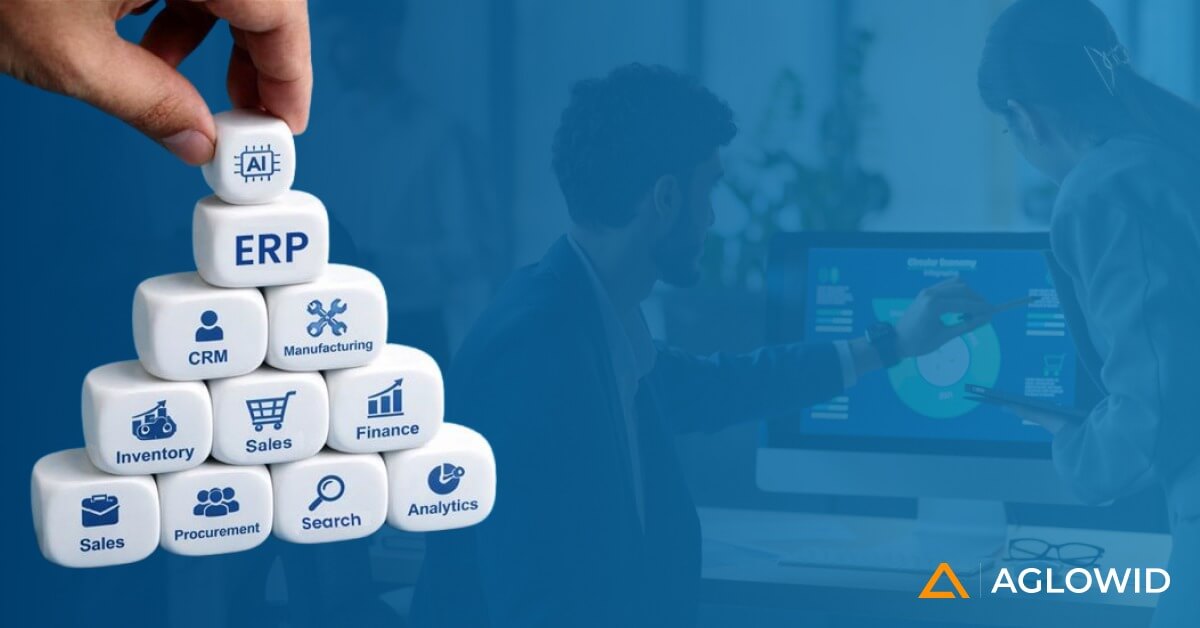
An ERP system acts as the operational backbone of the business. Instead of relying on multiple applications for different functions, ERP centralizes critical processes such as inventory management, procurement, financial operations, order fulfillment, and supply chain planning. For Shopify businesses, this means Shopify continues to manage storefront transactions while ERP becomes the system of record for operational data.
Many companies reach this point gradually as operational friction builds over time. Some common signals include:
- Inventory numbers frequently do not match across systems
- Teams spend significant time reconciling reports
- Procurement decisions become reactive rather than planned
- Supply chain visibility becomes limited
- Financial closing cycles grow slower and more complex
When these challenges begin appearing regularly, it often indicates that the existing Shopify app stack can no longer support the scale of the business.
We have covered this transition in more detail in our guide on when to connect ERP to Shopify, which walks through common growth signals and integration patterns for scaling brands.
Why ERP Must Come Before AI
This shift toward ERP also lays the groundwork for the next major capability: AI-driven operations.
While AI technologies are transforming ecommerce operations, they rely heavily on clean, structured, and consistent data. Systems need reliable records of order history, inventory movements, supplier performance, pricing trends, and demand patterns in order to generate accurate insights.
When operational data is scattered across disconnected applications, AI tools struggle to produce reliable forecasts or recommendations. In contrast, ERP systems create a centralized and structured data environment, capturing operational transactions across inventory, procurement, finance, and fulfillment.
Once this data foundation exists, AI can begin delivering meaningful value, improving demand forecasting, optimizing inventory planning, supporting procurement decisions, and generating deeper operational insights.
In practical terms, ERP provides the operational data foundation that allows AI to move from experimentation to real business impact.
To better understand how this transition changes day-to-day operations, the following comparison highlights the difference between managing a Shopify business through disconnected apps and operating with an integrated ERP + AI infrastructure.
| Operational Area | Shopify + Apps Approach | ERP + AI Approach |
|---|---|---|
| Inventory Management | Managed through multiple apps with sync delays | Centralized inventory with real-time visibility |
| Procurement | Manual purchase planning | AI-assisted demand forecasting and replenishment |
| Financial Reporting | Data pulled from multiple systems | Unified financial data within ERP |
| Supply Chain Planning | Reactive decision-making | Predictive planning using historical data |
| Operational Visibility | Fragmented across tools | Single source of operational truth |
Where AI Creates Real Operational Value for Shopify Businesses
Once ERP establishes a centralized operational data foundation, AI technologies can begin delivering meaningful business value. Rather than relying on fragmented information from multiple apps, AI models gain access to consistent historical data across inventory, orders, procurement, and financial operations.
This shift allows businesses to move beyond reactive management and toward predictive, data-driven operations.
Demand Forecasting and Inventory Planning
One of the most immediate benefits of AI is improved demand forecasting. By analyzing historical sales patterns, seasonal trends, and customer behavior, AI models can predict product demand with far greater accuracy.
This helps businesses plan inventory more effectively, reducing the risk of both stockouts and excess inventory. Better forecasting also improves working capital efficiency, allowing brands to allocate resources more strategically.
Intelligent Procurement and Replenishment
AI can also support smarter procurement decisions. Instead of relying on manual purchasing decisions or static reorder rules, AI systems can recommend optimal replenishment timing and quantities based on demand forecasts, supplier lead times, and inventory levels.
For growing Shopify businesses managing global supplier networks, this capability significantly improves supply chain coordination and operational efficiency.
Financial Forecasting and Margin Visibility
Another important application of AI lies in financial forecasting. With integrated operational data from ERP, AI systems can analyze revenue trends, inventory costs, and channel performance to provide deeper insights into business profitability.
This allows leadership teams to better anticipate cash flow needs, evaluate product margins, and make more informed strategic decisions.
Customer and Demand Pattern Insights
AI can also reveal patterns in customer purchasing behavior that may not be obvious through standard analytics tools. These insights help businesses align marketing strategies with inventory planning, ensuring that supply chains can support changing demand patterns.
When ERP and AI operate together, organizations gain the ability to anticipate demand rather than simply reacting to it.
Signals Shopify Businesses Are Ready for ERP + AI
Not every Shopify business needs ERP or AI immediately. However, certain operational signals indicate that the existing technology stack may no longer support the scale and complexity of the business.
These signals often appear gradually as the organization grows.
Some of the most common indicators include:
- Inventory numbers frequently differ across systems
- Teams rely heavily on spreadsheets for reporting and reconciliation
- Procurement decisions are reactive instead of forecast-driven
- Financial closing cycles take longer as data must be consolidated from multiple sources
- Operational teams spend increasing time coordinating systems rather than managing the business
When these challenges begin appearing regularly, it often suggests that the organization is approaching the point where centralized operational infrastructure becomes necessary.
At this stage, implementing ERP can provide the data foundation required to improve operational visibility and enable future AI capabilities.
The Future of Shopify Operations with ERP and AI
Commerce operations are becoming increasingly data-driven. As Shopify businesses expand across channels, markets, and supplier networks, operational complexity will continue to grow.
In this environment, scalable organizations will rely on integrated operational systems rather than disconnected app stacks.
For Shopify‑first brands that are gradually evolving into true multi‑store, multi‑channel retailers, our overview of retail chain management software illustrates what a more mature operational stack can look like beyond the early app‑based approach.
ERP systems provide the centralized infrastructure needed to manage inventory, procurement, finance, and supply chain processes. Once this foundation is established, AI technologies can begin transforming how businesses plan, forecast, and make strategic decisions.
The result is a shift from reactive operations toward predictive and intelligent commerce management.
For growth-focused Shopify brands, the key question is no longer whether ERP and AI will become part of their operational strategy. The more important question is when to begin building the infrastructure that will support long-term scale and operational control.