
You have the platform. You have the features switched on. So why are your operations still running on human judgment, spreadsheets, and firefighting? The honest answer is not what Shopify wants you to hear.
Picture a brand doing $15 million in annual GMV. They are utilizing advance full spectrum Shopify Plus Services. Every AI feature is enabled. Shopify Magic is writing their product descriptions. The recommendation engine is live. Sidekick is fielding internal queries. On paper, they are a modern AI-powered retail operation.
In practice, their inventory manager is still manually adjusting purchase orders every week because the platform data does not account for supplier lead times. Their merchandising team is running promotions based on last quarter’s margin reports, not live margin data. Their customer service backlog grows every Monday because the AI cannot handle anything more complex than a tracking query.
This is not an unusual story. It is, in fact, the norm for retailers who have done everything right by the Shopify playbook and are still discovering that at a certain scale, the native AI toolkit stops being an accelerant and starts being a ceiling.
This piece is about that ceiling. Where it sits, why it exists, and what operators who have broken through it have done differently.
First, let’s be honest about what Native Shopify’s AI does well
A credible argument requires acknowledging the genuine value first. Shopify’s native AI features are not gimmicks. Collectively, they reduce friction across content, discovery, fraud, support, and reporting in ways that create real time savings for growing merchants. Here is what each tool actually does and where it earns its keep.
| Tool | What it does | Where it works well |
| Shopify Magic – Content | Generates product descriptions, email copy, blog drafts, and ad text from prompts or existing product data | High-SKU catalogs needing fast content production; teams without dedicated copywriters |
| Sidekick – Assistant | Conversational AI assistant for store queries, basic reporting, and operational guidance within the Shopify admin | Founders and small ops teams needing quick answers without digging through dashboards |
| Search and Discovery – Discovery | AI-powered product search, filtering, and co-purchase based recommendations displayed on storefront | Stores with broad catalogs where surfacing relevant products drives conversion |
| Shopify Inbox – Support | Live chat with AI-suggested replies, automated FAQs, and basic order status responses | Handling high volumes of simple pre-purchase and post-purchase queries at low cost |
| Shopify Protect – Fraud | Automated fraud detection and chargeback protection on eligible orders using Shopify’s transaction data network | Brands scaling order volume without the resources to manually review transactions |
| Shopify Analytics – Reporting | Pre-built and custom reports across sales, traffic, customer behavior, and inventory with basic trend identification | Teams needing clean operational visibility without a dedicated data analyst |
These features are genuinely useful at the $1M to $5M revenue stage. They reduce time on low-complexity tasks and lower the operational floor for growing merchants. But they are horizontal features, built for the average merchant across two million stores, not vertical solutions built for your specific operational complexity. That distinction becomes expensive to ignore as you scale.
The Scaling Inflection Point: Where the Native Shopify AI isn’t Enough
There is a specific revenue band where native Shopify AI begins to visibly fail, roughly between $8M and $50M in annual GMV. The pain does not arrive suddenly. It accumulates quietly through decisions made on incomplete intelligence, until the cost becomes impossible to ignore. Each crack below follows the same pattern: a symptom your team already recognizes, and a platform gap that is causing it.
Inventory and forecasting (High impact)
“We are either sitting on too much stock or running out at the worst possible time.”
The platform gap: Shopify provides historical sales data and low-stock alerts. It has no multi-location replenishment logic, no supplier lead time modeling, and no external signal integration. A 600-SKU operation across three warehouses cannot run on that foundation.
Business cost: working capital tied up in overstock, lost sales and customer trust from stockouts
Personalization (High impact)
“Our recommendations feel generic. We are treating our best customers the same as first-time visitors.”
The platform gap : Search and Discovery works on co-purchase and browse behavior. It does not segment by lifetime value, purchase frequency, category affinity, or real-time behavioral signals. There is no differentiation between a customer worth $8,000 and one worth $80.
Business cost: lower repeat purchase rates, weakened loyalty, missed upsell and cross-sell revenue
Customer service (High impact)
“Our support backlog grows every week even though we have AI switched on.”
The platform gap: Shopify Inbox handles simple transactional queries well. Complex returns, loyalty questions, subscription changes, or multi-order issues either receive incorrect AI responses or escalate to a human agent with no structured context from the prior interaction.
Business cost: rising resolution times, invisible churn from poor post-purchase experience
Pricing and merchandising (Medium impact)
“We are setting prices and running promotions without knowing if they are actually margin-positive.”
The platform gap: Shopify offers manual rules-based discounts with no dynamic pricing engine, no competitor price awareness, and no margin-aware promotional logic. Every pricing decision is made without a live understanding of its true profitability.
Business cost: margin erosion on promotions, missed competitive pricing opportunities
Operational analytics(Medium impact)
“Our dashboards tell us what happened last week. They do not tell us what to do about it.”
The platform gap: Shopify Analytics is clean and accessible. It is descriptive, not prescriptive. It surfaces what happened. It does not explain why, recommend a response, or model what happens if you change a variable. For a team making daily decisions with five and six-figure consequences, the difference between descriptive and prescriptive intelligence is not academic.
Business cost: slow response to performance shifts, decisions made on intuition rather than modeled outcomes
In every one of these areas, the failure mode is identical. Shopify’s native AI is descriptive and reactive. Scaling operations require intelligence that is predictive and prescriptive. That is not a gap Shopify is likely to close, because closing it would mean building category-specific depth that conflicts with serving two million merchants simultaneously.
This is not Shopify’s failure. It is a structural reality
Before the instinct kicks in to find a better platform, it is worth pausing on something. Every gap in the previous section exists not because Shopify built something poorly. It exists because Shopify was never designed to solve those problems in the first place.
Platform-native AI is built to serve everyone. That is precisely why it cannot serve you specifically.
Shopify serves over two million merchants across every category, size, geography, and operational model. Their AI has to be generic enough to be useful to a candle shop in Austin and a fashion brand scaling across European markets simultaneously. Building deep, vertical intelligence for mid-market operations would mean abandoning the breadth that makes Shopify valuable to most of its merchants. It is not a trade-off they can make. And understanding that changes the question you should be asking.
The question is not: how do I get Shopify to do more? The question is: what should Shopify do, and what should sit on top of it?
This is not a new idea. Enterprise software has operated this way for years. The analogy is direct.
Salesforce is a great CRM. But serious revenue teams don’t rely on it alone. They treat it as infrastructure and layer tools like Gong, Clari, and Outreach on top. Because competitive advantage doesn’t come from the system. It comes from the intelligence built around it.
The same applies to ecommerce.
Shopify is world-class infrastructure. But the best merchants don’t stop there. They run operations on Native Shopify AI tools and build intelligence layers for forecasting, personalization, and pricing. Infrastructure runs the business. Intelligence drives growth.
The pattern is identical. Nobody expects Salesforce to replace Gong. Nobody should expect Shopify to replace a demand forecasting engine. Best-of-breed stacks win in complexity because they separate infrastructure from intelligence.
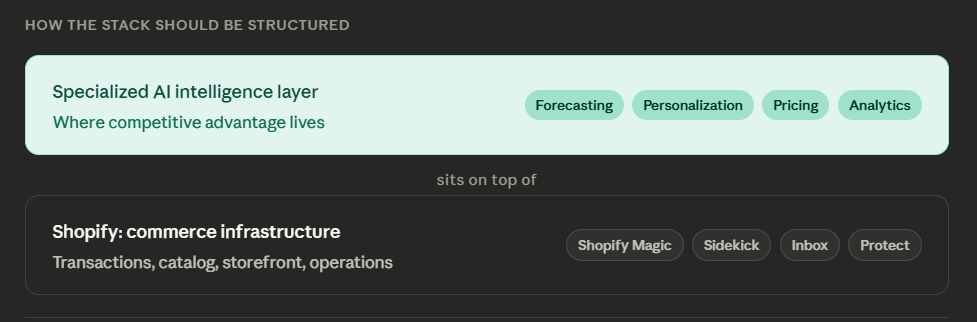
The merchants who scale most effectively are not those chasing a single platform to do everything. They are the ones who are most deliberate about where platform intelligence ends and specialized intelligence begins. Drawing that line clearly is itself a competitive advantage.
What the Third-party Intelligence Layer Looks Like in Practice
This is not about stacking tools. It is about identifying the one or two operational functions where the intelligence gap is costing you the most measurable money, and addressing those first. The comparison below is functional, not a vendor endorsement.
Where Shopify Ends and Intelligence Begins
| Capability Area | Shopify Native AI (Infrastructure) | Specialized AI Layer (Intelligence) | Business Impact |
|---|---|---|---|
| Demand Forecasting & Inventory |
|
|
Improved stock availability, reduced stockouts, optimized inventory holding costs |
| Personalization & CX |
|
|
Higher conversion rates, improved retention, increased customer lifetime value |
| Pricing & Merchandising |
|
|
Better margin control, competitive positioning, optimized promotions |
| Analytics & Decision Support |
|
|
Faster decision-making, proactive risk management, data-driven execution |
The integration question: is this actually feasible?
It is a fair hesitation. The argument for a specialized intelligence layer sounds compelling in principle. But any operator who has lived through a bad integration knows that the gap between a good idea and a working implementation can be expensive, disruptive, and demoralizing. So let us address that directly.
“Will this mean ripping apart our existing Shopify setup?”
No. The intelligence layer sits on top of Shopify, not inside it. Your commerce infrastructure stays exactly as it is.
“How difficult is the technical integration?”
Most modern AI tools built for ecommerce have mature Shopify connectors or well-documented APIs. Technical integration is rarely the hardest part of this process.
That last point is worth sitting with, because it runs counter to how most operators frame the risk.
The real implementation risk
The cost is not the integration. It is the change management.
Getting your team to trust new signals over existing instincts, ensuring your data hygiene is strong enough for AI models to produce reliable outputs, and deciding who owns the intelligence layer strategically. These are organizational challenges, not technical ones. And they are best solved by starting small, not by planning comprehensively.
Which brings us to the most important practical question: where do you start? The operators who do this well do not overhaul everything at once. They pick one function, prove the value, and expand from there. Here is what that looks like in practice.
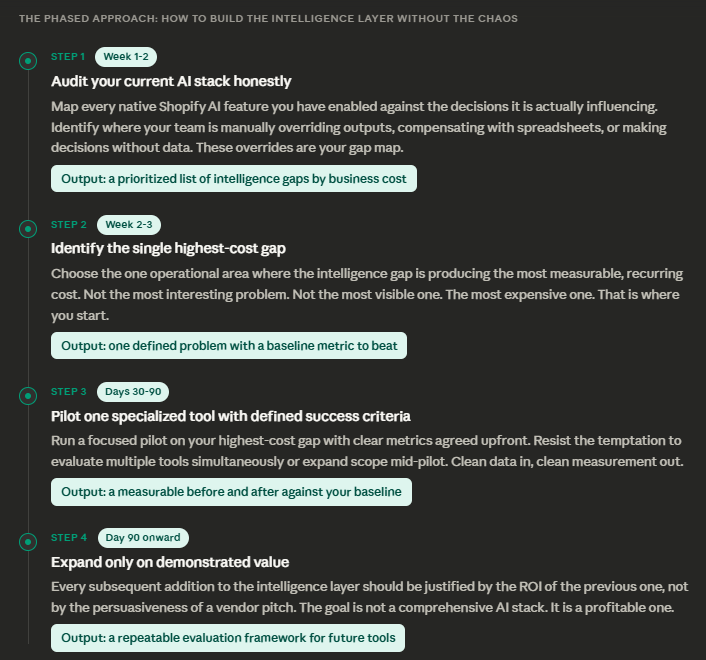
This approach sounds slower than a full-stack overhaul. In practice it is faster, because every expansion is grounded in demonstrated value rather than speculative ROI. The operators who try to solve everything at once almost always end up solving nothing well.
How to know you have actually hit the ceiling
The ceiling rarely hits like a brick wall, it creeps in through operational red flags that signal Shopify AI can’t keep pace with your growth.
Diagnostic Checklist: Are You Hitting the Ceiling?
Score yourself: Check off patterns present today. 3+ checks means you’ve outgrown native tools and its time for scalable solutions.
| Pattern | Key Symptom | What It Reveals | Quick Self-Check |
| Manual AI Overrides | Team rejects >50% of AI recommendations (search, recs, pricing) | Model lacks context for complex ops; outputs feel generic | Track 1 week’s Shopify Magic/Rufus usage logs |
| Staff as Gap-Fillers | Analysts/ops hires spend 60%+ time on manual workarounds (tagging, forecasting) | Platform intelligence gaps drain resources from growth | Review last 3 job descriptions or time tracking |
| Stalled Personalization | Email CTR <15%, rec click-through <10%, repeat rate flat despite 20%+ traffic growth | AI personalization plateaus; can’t handle nuanced segments | Compare last 6 months’ Klaviyo/Shopify Email metrics |
| Predictable Inventory Pain | Same categories see stockouts/write-offs every quarter (e.g., seasonal apparel) | Forecasting ignores multi-channel patterns, supplier delays | Pull Q1-Q4 inventory reports spot repeats? |
| CS Overload | Resolution time up 20%+ as orders grow; tickets spike on peak days | AI chat/self-serve can’t absorb query complexity | Check Gorgias/Zendesk trends vs. order volume |
| Spreadsheet Pricing | Weekly Excel rituals for promos/margins instead of live dashboards | No real-time, margin-aware decisions across 10K+ SKUs | Ask: “When was last dynamic price test?” |
Threshold Action Guide
- 1-2 checks: Monitor quarterly and tweak apps first.
- 3-4 checks: Urgent audit. Test API-driven AI agents now.
- 5-6 checks: Scale bottleneck confirmed. Integrate ERP (like Odoo) for omnichannel sync.
Pro Tip: Run this as a 2-minute team audit in your next ops meeting. Bold metrics make patterns pop visually which decision-makers scan tables first.
The Competitive Reality: Next Three Years
Retail is moving into a phase of structural compression: margins are tighter, acquisition keeps getting more expensive, and for most categories retention is now the primary growth lever, not net-new traffic. In that environment, the brands that win are the ones making better decisions faster across merchandising, inventory, pricing, and customer value and not the ones with the longest app list.
What Native Shopify AI Actually Gives You
Think of native Shopify AI as raising the operational floor, not defining your competitive ceiling:
- It keeps teams from drowning in repetitive work.
- It delivers “good enough” content, recommendations, and automation for the median merchant.
- It ensures you meet the baseline intelligence customers now expect.
What it does not do is encode your unique economics, demand patterns, and strategy in a way that other brands cannot easily copy. That is the job of a separate, deliberate decision layer.
How Winning Retailers Are Responding
The retailers pulling ahead are very clear on one simple line:
- The platform runs transactions and basic intelligence.
- Their own layer runs the decisions that protect and expand margin.
They invest in that specialized layer whether via an Odoo ERP Integration into Shopify, custom decision engines, or both and they treat it as a margin asset, not a technical expense.
The One Question to Sit With
Instead of asking:
“Is our Shopify AI working?”
They ask:
“Where are we most often overriding what the platform recommends, and what is that pattern costing us each quarter?”
Those override zones are almost always the right starting points for a smarter decision layer.
If you can already see those override patterns in your own operation and want to turn them into an advantage instead of a tax, let’s map it properly: book a working session with our team, bring your last quarter of exceptions, and we’ll show you exactly where native Shopify AI should end and where your competitive intelligence needs to begin.