
Quick Summary
ERP modernization is no longer a technical upgrade decision, it is a strategic inflection point for mid-market organizations. While many leaders assume replacement is the only path forward, this article clarifies why that is often not the case. The real decision is not repair vs replace in isolation, but how well your ERP can support future growth, data-driven decisions, and operational scale. This blog explores both paths, their trade-offs, and how mid-market firms can take a hybrid, risk-balanced approach to ERP transformation.
Your ERP was supposed to make things easier. So why does running the business sometimes feel like working around the system instead of with it?
Sounds familiar? – Your finance team exports data to Excel every week because the ERP cannot generate the report they need. Your operations head has built a shadow system in Google Sheets to track what the ERP misses. And every time someone from IT mentions an upgrade, the room goes quiet – because the last one took 18 months and still did not fully work.
This is not a technology problem. It is a decision that has been postponed too long. And you are not alone. Across mid-market companies, the ERP conversation gets shelved quarter after quarter – too expensive, too risky, too disruptive. Until the cost of not deciding becomes impossible to ignore.
This guide is for the decision makers who are done postponing. Whether you are leaning toward fixing what you have or replacing it entirely, this is a structured way to think it through – without the vendor spin.
Why your ERP is underperforming – and why it matters now
Most mid-market ERPs were implemented anywhere between 5 and 15 years ago. At the time, they fit. The business was smaller, simpler, and the processes were different. Since then, the company has grown, the team has changed, and customer expectations have shifted. But the ERP has largely stayed the same.
What you end up with is a system that is technically operational but functionally limiting. It runs the basics, but it cannot run the business the way the business actually needs to run today.
The danger is not that the ERP stops working. It is that it keeps working just well enough to delay the right decision.
The result shows up everywhere: manual workarounds that eat hours, data silos that slow decisions, integration debt from years of duct-taped connections, and talent friction from teams that resent the tool they are forced to use every day.
And the macro environment is not waiting. Supply chain volatility, hiring pressures, customer experience expectations, compliance requirements – these are not slowing down. Your ability to respond to them depends significantly on whether your core system is working with you or against you.
There is also an emerging cost that does not show up in any report yet: AI readiness. The wave of intelligent automation, demand forecasting, invoice processing, anomaly detection runs on clean, connected, real-time data. If your ERP cannot provide that foundation, you are not just behind today. You are locked out of what comes next.
If parts of your landscape still rely on heavily customized, on‑premise systems, you may need a broader legacy system modernization lens instead of looking at ERP in isolation.
If you are rethinking how your ERP fits into a broader modernization roadmap, it often helps to step back and look at your overall digital transformation strategy first.
The Real Question Isn’t “Upgrade or Replace”
Most organizations frame the problem incorrectly.
They ask:
- Should we upgrade our ERP?
But high-performing mid-market companies ask:
- Can our ERP support where the business is going in the next 3-5 years?
This subtle shift changes everything.
Instead of focusing on system limitations alone, you evaluate:
- Business complexity vs system flexibility
- Data architecture vs reporting needs
- Decision speed vs data availability
Because ultimately, ERP modernization is about enabling better decisions, not just better systems.
For many SMBs, ERP is just one pillar in a broader digital transformation roadmap, so the modernization decision should align with where you want the whole business to be in three to five years.
What “repair” actually means
Repair is not just putting a patch on a problem. Done right, it can be a legitimate modernization path. But it has to be the right kind of repair for the right kind of problem.
Here is what repair can look like in practice:
Repair options that can work
- Adding modules your current vendor now offers
- Integrating best-of-breed tools for specific gaps
- Migrating to the cloud version of the same ERP
- Reconfiguring workflows without custom code
- Cleaning up years of data and process debt
If you are running SAP ECC or an older version of Microsoft Dynamics, migrating to their cloud counterparts – S/4HANA or Dynamics 365 – is a legitimate repair path before committing to a full platform change.
Where repair tends to fail
- Heavy custom code that locks you further in
- Workarounds built on top of workarounds
- Adding integrations to an outdated core
- Upgrading a platform the vendor is phasing out
- Ignoring root-cause process problems
Repair works when the underlying architecture is sound, the vendor is actively investing in the platform, and the gaps you are trying to close are genuinely addressable without deep customization. It tends to fail when it becomes a way to avoid the harder conversation.
The honest question to ask: are you repairing a functional system, or are you defending a decision that was made a decade ago?
What “replace” actually means
The word “replace” tends to trigger a specific fear response in mid-market organizations: a multi-year big-bang implementation, massive disruption, and a bill that looks like a CFO’s nightmare. That fear is not unreasonable – those projects have happened. But they are not the only way replacement works.
Modern ERP replacement has matured. Today it can look like:
Modern replacement approaches
1 – A phased rollout – replacing one business area at a time, keeping the rest operational throughout the transition
2 – A best-of-breed strategy – replacing the ERP core and connecting specialized tools for finance, operations, or CRM that do those jobs better
3 – A platform consolidation – moving from three or four fragmented systems into one unified platform that reduces complexity
4 – A cloud-native migration – shifting entirely to a SaaS ERP model that reduces infrastructure burden and enables continuous updates
None of these require you to stop the business for two years. What they do require is honest planning, the right implementation partner, and executive commitment to the process.
The mid‑market teams that navigate replacement well follow a disciplined playbook of ERP implementation best practices around scope, phasing, and change management.
For many mid-market firms, modern, modular platforms like Odoo ERP provide a more flexible way to phase replacement without taking on a monolithic, multi‑year program.
The decision framework: how to actually choose
The repair vs replace decision is not made at the product level. It is made at the business level. Here is a practical framework to work through – answer these questions honestly, and the direction will become clear.
-
Vendor and platform viability
Is your ERP vendor actively investing in the version you are running? Are there regular product updates, a live support organization, and a clear roadmap? If the version you use has been labelled legacy or is approaching end-of-support, repair is not a strategy – it is a delay.
-
Total cost of ownership
Do not just look at the license fee. Count the full picture: custom development maintenance, integration management, the IT hours spent keeping it running, and the hidden cost of manual workarounds. For many mid-market companies, the true cost of keeping an aging ERP is significantly higher than anyone has formally calculated. Run that number before comparing it to the cost of replacement.
-
Integration and customization debt
How many custom modifications have been made to your ERP over the years? How many third-party tools has it been connected to? Every customization and integration adds maintenance burden and upgrade risk. If your ERP has become so heavily modified that upgrades are effectively impossible, the repair path is already closed – you just have not admitted it yet.
-
User adoption and shadow IT
One of the most reliable signals of an underperforming ERP is what people are doing beside it. If your teams have built their own tracking systems in spreadsheets, messaging apps, or personal tools, that is not a training problem. That is a system problem. Shadow IT is the organization’s way of telling you the ERP does not serve them.
-
Scalability against your growth plan
Think about where your business needs to be in three to five years. New markets, new product lines, acquisitions, headcount growth, or expanded compliance requirements. Can the current ERP scale to support that? Not with effort and workarounds, but cleanly – the way a system should? If the answer requires significant qualification, that is a signal.
-
Real-time data and decision-making capability
Modern business runs on real-time visibility. Inventory positions, cash flow, delivery performance, margin by product line – these should be available in minutes, not days. If your leadership team is making decisions on data that is 48 to 72 hours old because of how reporting works in your ERP, you are already running behind. Strengthening your data analytics layer alongside ERP modernization is often the fastest way to close this decision‑latency gap.
This matters more than it did two years ago. AI agents and intelligent workflows are only as useful as the data they run on. A system that cannot surface real-time inventory or cash positions cannot support the next generation of automated decision-making – regardless of what tools you layer on top of it.
| Decision Area | Repair ERP | Replace ERP |
| Vendor Viability | Declining / Limited | Strong / Future-ready |
| Total Cost of Ownership | Lower upfront, higher long-term | Higher upfront, lower long-term |
| Customization & Integration Debt | High dependency, increasing burden | Reset to clean, manageable |
| User Adoption & Shadow IT | Low adoption, high workarounds | Higher adoption, streamlined usage |
| Scalability | Limited / constrained | High / scalable |
| Real-Time Decision Capability | Delayed / batch-based | Real-time / near real-time |
Red flags that mean replace, not repair
Some signals are not ambiguous. If any of the following apply to your situation, a repair path is unlikely to solve the underlying problem.
Non-negotiable replacement signals
- Your vendor has announced end-of-life or end-of-support for your current version within the next 24 months
- The system cannot support remote or hybrid work without significant workarounds
- You have had a compliance gap or audit finding that the ERP was unable to prevent or detect
- Your last major upgrade took more than 12 months and still required post-go-live fixes for basic functionality
- The system cannot be accessed from mobile devices and your operations require it
- You have acquired another business and cannot integrate their operations into your ERP
- Key vendor or customer integrations require workarounds because native connectors do not exist
For Example: SAP ECC 6.0 mainstream maintenance ends in 2027. If you are still on it and have not started planning your path to S/4HANA or an alternative, the clock is no longer in your favor. Oracle E-Business Suite and older Infor versions are in similar territory.
If two or more of these apply, the question is no longer whether to replace – it is when and how.
Mistakes Leaders Often Make – And How to Avoid Them
The companies that struggle most with ERP modernization tend to make the same set of errors. Recognizing them early saves a significant amount of time, money, and internal credibility.
Many well‑intentioned projects end up as classic ERP implementation failures not because the technology was wrong, but because decisions around scope, ownership, and rollout were mis‑handled.
Mistake 01 – Choosing on price alone
The lowest implementation cost rarely reflects the total cost. Factor in change management, training, integration work, and ongoing support before comparing.
Mistake 02 – Over-customizing to match old processes
New ERP implementations fail most often when companies force the system to replicate what they already do. Modernization is also a process redesign opportunity.
Mistake 03 – Underinvesting in change management
Technology is the easier part. Getting 200 people to change how they work every day is where projects succeed or fail. Budget for it accordingly.
Mistake 04 – Starting without executive ownership
ERP decisions made purely at the IT level rarely survive contact with the business. This needs a named executive sponsor with real authority and accountability.
Mistake 05 – Delaying indefinitely
Every quarter you delay, technical debt compounds. The decision does not get easier with time – only the consequences of not deciding get larger.
Mistake 06 – Skipping the vendor selection process
Choosing the first vendor who demos well is a common and costly mistake. A structured evaluation with defined criteria prevents expensive regret 18 months in.
The hybrid path: where most mid-market firms actually land
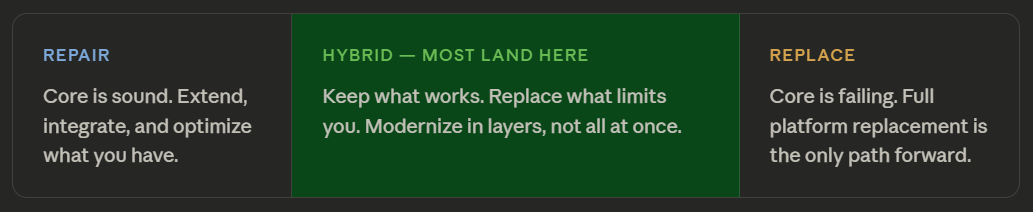
If you have read this far and found yourself thinking “we are not quite in the repair camp, but full replacement feels too aggressive right now” – that instinct is probably right. And it is more common than the industry conversation suggests.
Most mid-market organizations do not face a binary choice. They face a spectrum. The real question is not whether to repair or replace – it is which parts of the business need which treatment, and in what sequence.
That is what a hybrid strategy is. Not a compromise. Not a half-measure. It is a deliberate architecture decision that treats different parts of your ERP landscape differently, based on where the value is and where the risk is highest.
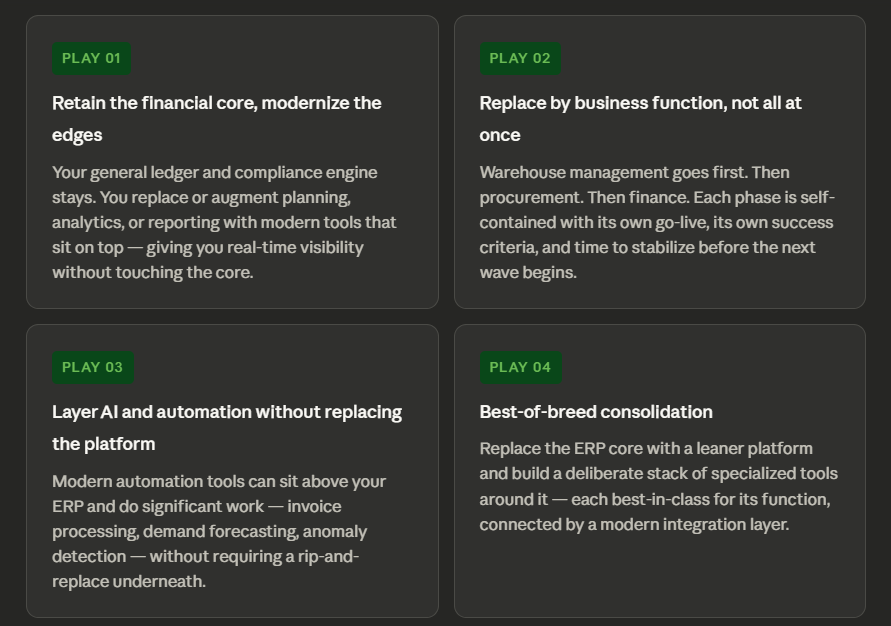
What hybrid actually looks like in practice
Hybrid is not a single approach – it is a category with several distinct plays. The right one depends on where your largest constraints are.
When hybrid is the right call
Your ERP core is stable but specific modules are failing you
The platform is not the problem – particular functions are. Targeted replacement is more efficient than wholesale change.
You cannot absorb the disruption of a full replacement right now
A major acquisition, rapid headcount growth, or a leadership transition can make full replacement timing genuinely wrong. Hybrid lets you move without stopping the business.
You need to prove value to the board before committing to the full investment
Phasing allows you to show measurable ROI from early stages, which makes the business case for subsequent phases significantly easier to approve.
Your technology debt is uneven across business functions
Finance is fine but operations is struggling. Manufacturing is modern but sales and forecasting are not. Hybrid lets you address the worst problems first.
Hybrid done well is not hedging. It is precision. You are applying modernization exactly where it delivers the most value, in the sequence that carries the least risk.
The one thing that kills hybrid strategies
Hybrid fails when it becomes an excuse to avoid making hard architectural decisions. If every difficult call gets deferred into the hybrid bucket – “we will deal with that in phase three” – the strategy quietly turns into a permanent state of partial modernization. You end up neither repaired nor replaced, just more complicated.
Watch for this
The clearest warning sign is when the number of integration points between old and new systems starts growing faster than the number of systems being retired. If your hybrid strategy is adding connections rather than reducing them over time, the architecture is drifting – not converging.
A well-run hybrid strategy has a defined end state. You know what the architecture looks like in three years. Each phase moves toward it. The decisions made in phase one do not make phase three harder – they make it possible.
That discipline is what separates a hybrid strategy from a prolonged delay dressed up as a plan.
What a structured modernization path looks like
For organizations that have decided to move forward – whether repair or replace – the path that works most consistently follows a clear sequence. It is not complicated. It is just disciplined.
1 – Current-state assessment
A structured review of what you have: system performance, integration landscape, user pain points, customization debt, and total cost of ownership. This is the foundation everything else sits on.
2 – Decision clarity: repair or replace
Using the assessment findings, make the call with data – not assumption. This is the point where the right answer becomes clear for your specific context.
3 – Roadmap and business case
Build a sequenced plan with timelines, investment requirements, risk mitigation, and expected business outcomes. This is what you take to the board.
4 – Vendor selection (if replacing)
A structured process with defined criteria, structured demos, reference checks, and negotiation support. Not a beauty contest. A clear framework for choosing the right ERP system keeps the team focused on fit, viability, and long‑term value instead of being swayed by the flashiest demo.
5 – Phased implementation and adoption
Roll out in controlled phases with clear success metrics at each stage. Treat adoption as a separate workstream – not an afterthought.
6 – Continuous optimization
The job does not end at go-live. Set a review cadence for the first 12 months to capture value, fix friction points, and build internal capability.
The 12 months after go-live are also when workflow automation and AI-assisted processes start delivering real returns because the data is finally clean, connected, and current enough to support them.
The question you should be asking right now
Not “should we repair or replace?” That question is too broad to be useful at this stage. The better question is: do we actually know what our current ERP is costing us – in money, in time, in business capability, and in opportunity?
Most mid-market companies cannot answer that cleanly. Establishing clear digital transformation KPIs around cost, agility, and decision speed makes it much easier to quantify what your current ERP is truly costing you. Not because the data does not exist, but because no one has formally assembled it. And without that picture, any decision – repair or replace – is based on opinion rather than evidence.
The companies that navigate ERP modernization well are not the ones with the best technology instincts. They are the ones who made the decision with the right information and committed to it fully.
You do not have to have the answer figured out before you start. You just have to be willing to look honestly at what the current situation is actually costing you – and what staying there for another three years will cost you after that.
Not sure where you stand?
We work with mid-market businesses to make this assessment clear and fast – without a six-month consulting engagement. If you want to know whether your ERP is a liability or just needs attention, that conversation takes about 30 minutes.
Book a free ERP Consultation