Quick Summary
Mid-market contractors across painting, plumbing, electrical, and HVAC are investing in software but still bleeding margin. The reason is rarely a bad tool. It is a fragmented stack of 5 to 8 tools that never share data. This blog breaks down the real cost of that disconnection, with numbers, and makes the case for why integrated ERP is the only architecture that holds up as contracting businesses scale.
Walk into any $10M to $30M contracting business today and you will find the same contradiction. The office runs software. The field runs an app. The estimator has a platform. The accountant has QuickBooks. By every definition, the business has gone digital.
And yet, every Monday morning someone is still manually pulling last week’s job data into a spreadsheet to figure out where the numbers actually stand.
That is not a people problem. That is a systems architecture problem. And it is quietly one of the most expensive operational decisions a mid-market contractor is not aware they are making.
The conversation around contractor digital transformation has spent years focused on the wrong variable. The question was always: which tool should we add? The right question is: why are none of our tools connected? Because until you answer that, every new platform you adopt becomes another island in an already fragmented stack, and your team becomes the bridge between all of them.
This is not a challenge unique to one trade or one region. It is showing up consistently across painting contractors, plumbing operators, electrical firms, and HVAC businesses that have crossed the threshold from owner-operated to management-run. The moment a contracting business has more than a handful of active crews, the cost of disconnected systems starts compounding in ways that are difficult to see but very easy to feel: in slow month-end closes, in margin surprises at job close-out, in billing that always seems to lag two weeks behind the work.
What follows is a direct look at why this happens, what it actually costs, and what a connected operation looks like once you fix it.
The Problem Nobody Puts a Number On
You have invested in software. Estimating tools, scheduling apps, job management platforms, accounting systems. Your team is not working off paper anymore. So why does it still feel like information is always one step behind the decision that needs it?
Here is the answer most technology conversations skip: the problem is not your tools. It is that your tools do not talk to each other. And in a $10M to $50M contracting operation, that silence costs real money.
20-30% of annual revenue is lost by companies operating with data silos. For a $10M contractor, that is $2M to $3M walking out the door every year. – CBH
This is not a technology gap. It is an integration gap. Mid-market contractors across painting, plumbing, electrical, and HVAC are running an average of 5 to 8 separate platforms across their operations, each generating data that never fully reaches the others. The result is a business that looks digital on the surface but operates on manual handoffs underneath.
The stakes are rising. Margins in specialty contracting are thinning, labor costs are climbing, and customers expect real-time visibility into their projects. In that environment, disconnected systems are not a minor inconvenience. They are a structural liability.
How the Stack Actually Looks Inside a $5M to $50M Contracting Company
If any of the following sounds familiar, you are operating with a disconnected stack.
No contractor set out to build a fragmented technology environment. What happened is rational: each department adopted the tool that solved their immediate problem.
- Estimating: a dedicated quoting tool or Excel
- Scheduling and dispatch: a field service app or shared calendar
- Job cost tracking: a spreadsheet updated every Friday
- Procurement and POs: email chains and supplier portals
- Invoicing and AR: QuickBooks or a standalone billing platform
- Field updates: WhatsApp groups and photos in email
Each of these tools works. The problem, as one industry analysis put it, is that “each system excels at its primary function, but they were never designed to share a conversation.” Sales optimizes for closing estimates. Operations optimizes for dispatching crews. Finance optimizes for billing cycles. And nobody owns the seam between them.
That seam is where contractor profitability lives and dies. A change order approved in the field that does not reach the estimating system. A purchase order that does not match the job budget because the budget is in a different system. An invoice that goes out 14 days late because billing is waiting on a completion report that was never filed digitally.
This is not a failing of your people. It is the predictable outcome of a technology architecture that was never designed to be unified.
The Five Real Costs of a Disconnected Stack
Each of the following cost areas has a number attached to it. These are not projections. They are documented outcomes from businesses operating the same kind of fragmented systems most mid-market contractors rely on today.
The Reconciliation Tax
Every week, someone in your business is manually pulling data from one system and re-entering it into another. Job costs from the field app into the accounting system. Purchase totals from email into the budget spreadsheet. Timesheet hours into payroll. This is what disconnected-system research calls the integration tax and it compounds silently. Businesses using disconnected legacy systems spend up to 30% more time reconciling financials compared to those on integrated platforms. Employees waste 8 to 12 hours per week on redundant data entry alone.
Field Labor Variance You Cannot See Until It Is Too Late
In MEP contracting, specifically HVAC, plumbing, and electrical, the performance gap observed between your top crew and an average crew performing the same scope is 30 to 40 percent. Same drawings. Same materials. Same job. One HVAC installation runs 40 hours. Another runs 55 to 60. That is a $1,300 labor cost variance on a single task. Across 15 to 20 projects a year, the math gets uncomfortable fast.
Without real-time job costing connected to field time tracking, you cannot see this variance until the project is closed. By then, the margin is already gone.
The Data Trust Breakdown
When financial and operational data live in separate systems, reporting becomes a consensus exercise rather than a factual one. “Since the data existed in various disconnected systems, there was no trust in the data. It was not accessible by shared departments. Financial reporting was done after the fact.” That observation from a Forvis Mazars construction industry analysis describes something every operations leader in a growing contracting business has experienced.
Bad data does not just produce wrong reports. It produces slow decisions, missed bids, and over-committed crews. It erodes confidence in the numbers, so leaders stop using the numbers.
Customer Experience Damage That Is Hard to Trace
Your project manager has one view of a job’s status. Your billing team has another. Your field supervisor has a third. When a client calls to ask about their project, the answer they get depends on who picks up the phone. This fragmentation has a documented business impact: 46% of organizations report that disconnected data negatively affects their ability to support and retain customers. In a referral-driven business like specialty contracting, that is not a statistic. That is reputation erosion.
The AI Investment That Returns Nothing
Many mid-market contractors are beginning to explore AI tools for scheduling optimization, predictive maintenance, or automated estimating. Here is the reality that most vendors will not tell you up front: AI is only as good as the data it can access. If that data is fragmented across five platforms that do not share a common schema, AI cannot do anything meaningful with it.
The data confirms this directly. Companies with strong system integration achieve a 10.3x ROI from AI initiatives. Companies with poor connectivity see just 3.7x. Disconnected infrastructure is not just a current problem. It is a ceiling on every future technology investment you make.
Summary: The Real Costs of Operating Disconnected
Cost Area |
What Is Happening | Quantified Impact |
| Reconciliation Time | Finance manually bridges data between field, PM, and accounting tools | 30% more time spent vs. integrated systems (2024 study) |
| Redundant Data Entry | Employees re-enter the same job data across 3 to 5 platforms | 8 to 12 hours lost per employee, per week |
| Field Labor Variance | No real-time job costing means margin erosion goes undetected mid-project | 30 to 40% performance gap between top and median crews (MEP data) |
| Revenue Leakage | Billing delays, missed change orders, and slow collections from fragmented invoicing | 20 to 30% annual revenue loss attributed to data silos |
| Customer Experience | Field team, office, and billing have different views of the same job | 46% of organizations report negative customer impact from fragmented data |
| AI/Automation ROI | AI tools layered onto disconnected stacks cannot access unified data | 10.3x AI ROI for integrated firms vs. 3.7x for disconnected ones |
Why Contractors Are Especially Exposed
The integration problem affects every industry. But contracting has a set of structural characteristics that make disconnected systems particularly damaging.
Consider the data flow in a single day of operations at a mid-market painting, plumbing, or electrical contractor. A crew lead updates job completion in the field. That update needs to reach: job costing, billing triggers, material reconciliation, subcontractor payment schedules, and next-job scheduling. In a connected system, that happens automatically. In a disconnected one, it becomes five separate manual actions across five separate platforms, each with its own delay and error rate.
The broader picture is striking. Research shows that organizations now run an average of 897 applications, but only 29% are integrated. For a contracting business, the consequences of that gap are not abstract. They show up as:
- Unbilled hours because the field app and the billing system are not synchronized
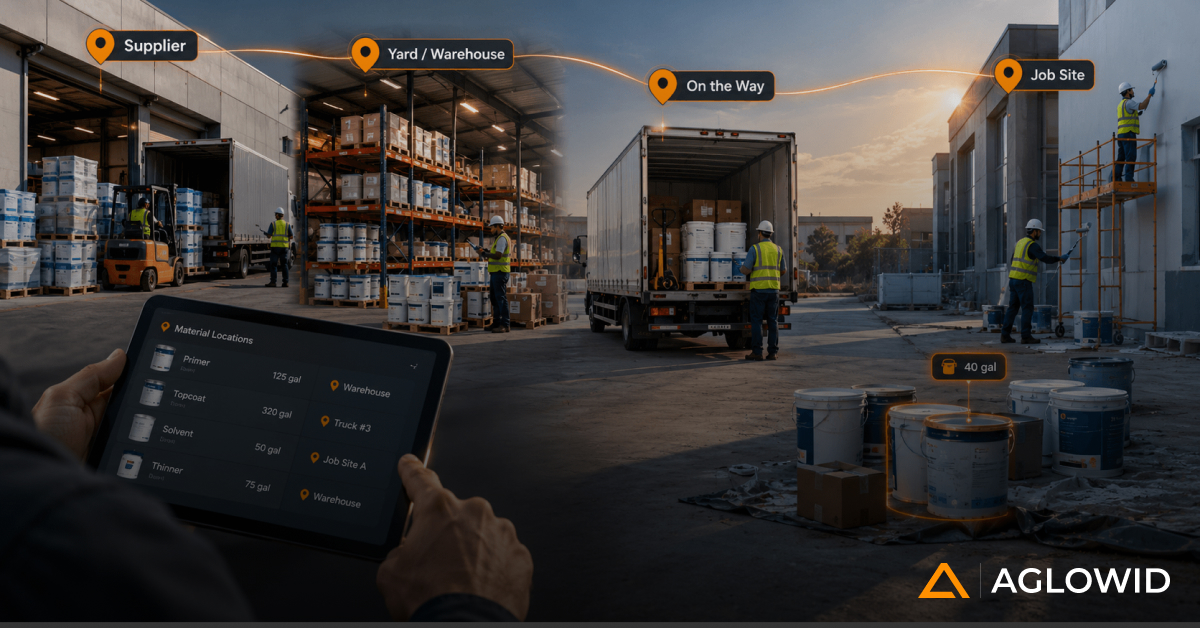
- Procurement overruns because purchase orders are not tied to live job budgets
- Payroll errors from timesheet data that never reaches HR automatically
- Compliance gaps because safety and completion records live in a different system than the project file
- Subcontractor disputes because contract terms and actual payments are tracked in two separate places
“The data existed in various disconnected systems. There was no trust in the data. Financial and project reporting was done after the fact. Real-time reporting was not available. This lack of integrity led to a breakdown in trust.” Forvis Mazars
This is the lived reality for a significant portion of mid-market contractors in 2026. And with private equity consolidation accelerating in trades like HVAC and plumbing, the companies that cannot demonstrate clean, integrated operational data are facing a strategic disadvantage well beyond their day-to-day inefficiencies.
What Connected Operations Actually Look Like in Practice
Integration is not a technology term. It is an operational outcome. Here is what it looks like in a contracting business where the systems work together.
Picture a mid-sized electrical contractor running 12 active crews across commercial and residential jobs. In a connected operations model, here is what a normal Tuesday looks like:
- 6:47 AM: A crew lead marks a rough-in phase complete on a mobile device. The system automatically updates the job cost ledger, triggers the next phase in the project schedule, and flags a material reorder for conduit stock that dropped below threshold.
- 9:15 AM: The project manager opens a single dashboard and sees real-time profitability across all 12 active jobs. Two jobs are running above labor budget. She adjusts crew allocation before the day compounds the variance.
- 11:30 AM: A client emails requesting a change order for additional panel work. The estimating module pulls live labor rates and current material costs, generates a quote in 20 minutes, and logs it against the project record.
- 4:00 PM: Jobs closed today automatically trigger invoice drafts. The billing team reviews and approves. Cash collection starts the same day work ends.
None of this requires AI. None of it requires a data analyst. It requires a single, unified contractor ERP platform where estimating, scheduling, job costing, procurement, invoicing, and field operations share one data model.
The contrast with a disconnected stack is not subtle. In a fragmented environment, every one of those moments involves a manual handoff, a potential error, or a delay that compounds by the end of the month. The difference between connected and disconnected operations is not a matter of being slightly more efficient. It is the difference between running your business on facts versus running it on approximations.
The Integration-First Evaluation Framework
When you evaluate a new platform, the framing of your questions determines the quality of the decision. Most mid-market contractors ask the wrong questions when assessing contractor management software.
The most common mistake is evaluating systems on license cost rather than total cost of ownership. Setup fees, data migration, training time, integration work, and productivity loss during transition all belong in that calculation. As one industry guide on HVAC software implementation puts it directly: “the cheapest platform is rarely the lowest-cost outcome.”
Here is the evaluation framework built specifically for mid-market contractor decision-makers:
Evaluation Dimension |
Wrong Question to Ask | Right Question to Ask |
| Pricing | What is the monthly license fee? | What is the total cost of ownership over 3 years including integration, training, and migration? |
| Integration Depth | Does it connect to my existing tools? | Can it replace my existing tools entirely, or does it add another silo? |
| Implementation | How fast can we go live? | What is the plan to migrate job history, open POs, and active projects without business disruption? |
| Field Adoption | Is there a mobile app? | Can a field technician log job updates, materials used, and time in under 60 seconds? |
| Reporting | Can I run reports? | Can my ops manager see real-time job profitability across all active projects from one screen? |
| Scalability | Will it handle our volume? | Does it support multi-crew, multi-trade, and multi-location operations without custom code? |
The underlying principle is this: integration depth matters more than feature breadth. A platform that covers estimating through invoicing within a single data model will always outperform a best-of-breed stack of six tools, regardless of how many features each individual tool offers.
One more criterion that rarely appears in vendor demos but consistently determines project success: implementation approach. A phased rollout with a clear data migration plan and defined go-live milestones is not a nice-to-have. It is the difference between a digital transformation that delivers ROI and one that stalls in the first quarter of deployment.
Check our Success Story
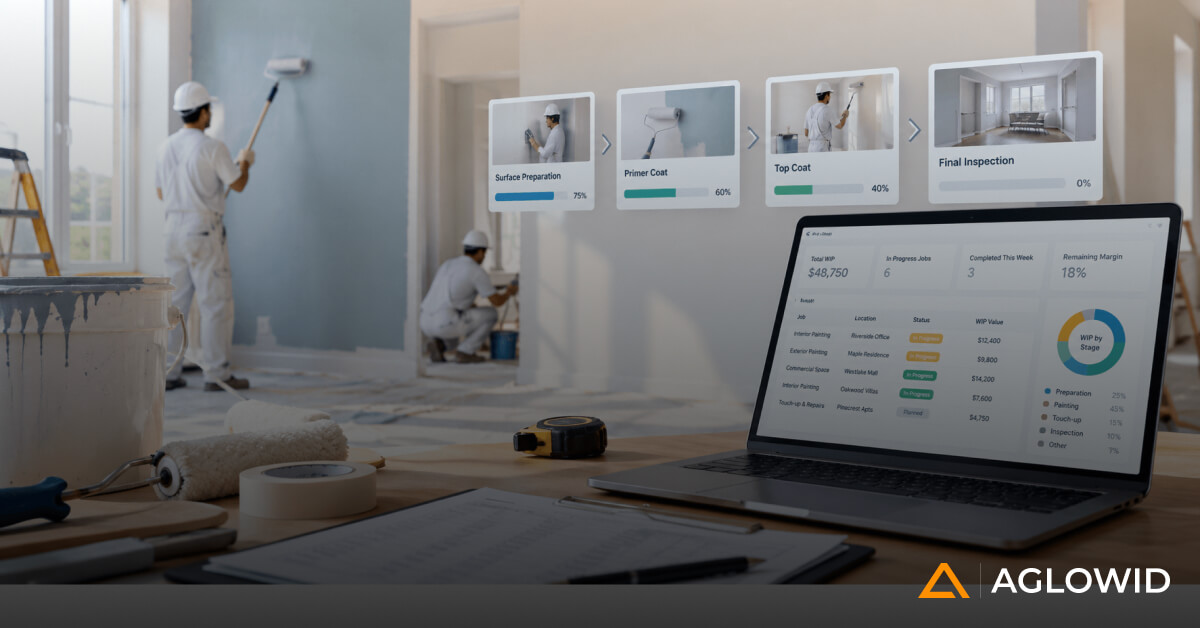
ERP Software for Painting & Coating Contractors
Centralizing Field, Finance, and Compliance with Odoo
Industry: Painting & Coating/Construction
Location: Canada
What We Learned Deploying Odoo for a Contracting Business
We recently completed a full Odoo ERP implementation for a painting and coating contractor. Here is what the data and the process confirmed.
We have spent years implementing ERP systems for field-service and contracting businesses. The Odoo deployment we recently completed reinforced four observations that apply directly to everything discussed above.
The integration gap was the first thing the client mentioned, and the last thing they had tried to fix
Before the project started, the client was running estimating in one tool, job tracking in another, and accounting in a third. The team had tried to bridge them with spreadsheet exports and weekly data syncs. The reconciliation process alone was consuming nearly two full days of administrative time every week. The moment we mapped a unified data flow, the business case for change became undeniable.
Field adoption was the real implementation challenge, not the technology
Getting the platform configured correctly is a solvable engineering problem. Getting a crew lead who has used the same scheduling app for four years to log job updates in a new system is a change management problem. The contractors who succeed with ERP implementations are the ones who involve field supervisors in the design process, not just the finance team.
Real-time job costing changed how the business made decisions
Within 60 days of go-live, the operations manager was reviewing job profitability daily rather than monthly. Two underperforming jobs that would previously have been identified at close-out were flagged mid-project, allowing labor reallocation that preserved margin. That single operational shift covered a significant portion of the implementation cost.
The total cost of ownership comparison made the decision straightforward
When we ran a full 3-year TCO comparison against the client’s existing stack including license fees, integration middleware, manual labor hours, and error-correction costs, the case for a unified Odoo-based platform was clear. This is consistent with broader market data suggesting that Odoo’s total cost of ownership runs 30 to 50% lower than comparable enterprise platforms at the mid-market scale.
“We did not realize how much time we were spending just moving data between systems until we stopped having to do it. The first month after go-live, our admin team reclaimed two full days a week.” – Operations Director, Specialty Contracting Client (post-implementation)
The Decision in Front of You
The contracting market is not getting simpler. Labor costs are climbing. Material lead times remain unpredictable. Project margins are thinner. And the customers writing the big checks, whether commercial property managers, general contractors, or institutional clients, are increasingly selecting trade partners based on operational credibility, not just technical capability.
Operational credibility, in 2026, means being able to answer questions in real time. What is the job costing right now? What is the current status of that change order? When will the invoice be ready? If answering those questions requires someone to open four different systems and compile the answer manually, you are carrying a structural disadvantage into every client conversation.
The gap between connected and disconnected operators is widening. Construction businesses that have committed to integrated digital infrastructure are already reporting measurable improvements in revenue and profitability. The businesses still running on fragmented stacks are not just missing efficiency gains. They are building a compounding liability into every year of growth.
The question is not whether your business needs integrated systems. The question is whether you address it on your timeline or under pressure.
Digital adoption leaders in contracting see an average of 1.4% revenue growth and 1% profit improvement vs. laggards. In a $20M contracting business, that is $280K in incremental revenue from systems alignment alone.
The contractors winning in this market are not running more tools. They are running fewer, better-connected ones. They have a single source of truth from estimate to invoice. Their field data and their financial data live in the same system. And their operations managers are making decisions on facts, not on Friday afternoon approximations.
That operating model is not a distant transformation. For a mid-market contracting business, it is one well-planned implementation away.
Is Your Stack Costing You More Than You Think?
We work with mid-market contractors to map their current technology stack, identify integration gaps, and build a connected operations model on Odoo. No generic demos. No pressure. Just a direct conversation about what is holding your business back.